






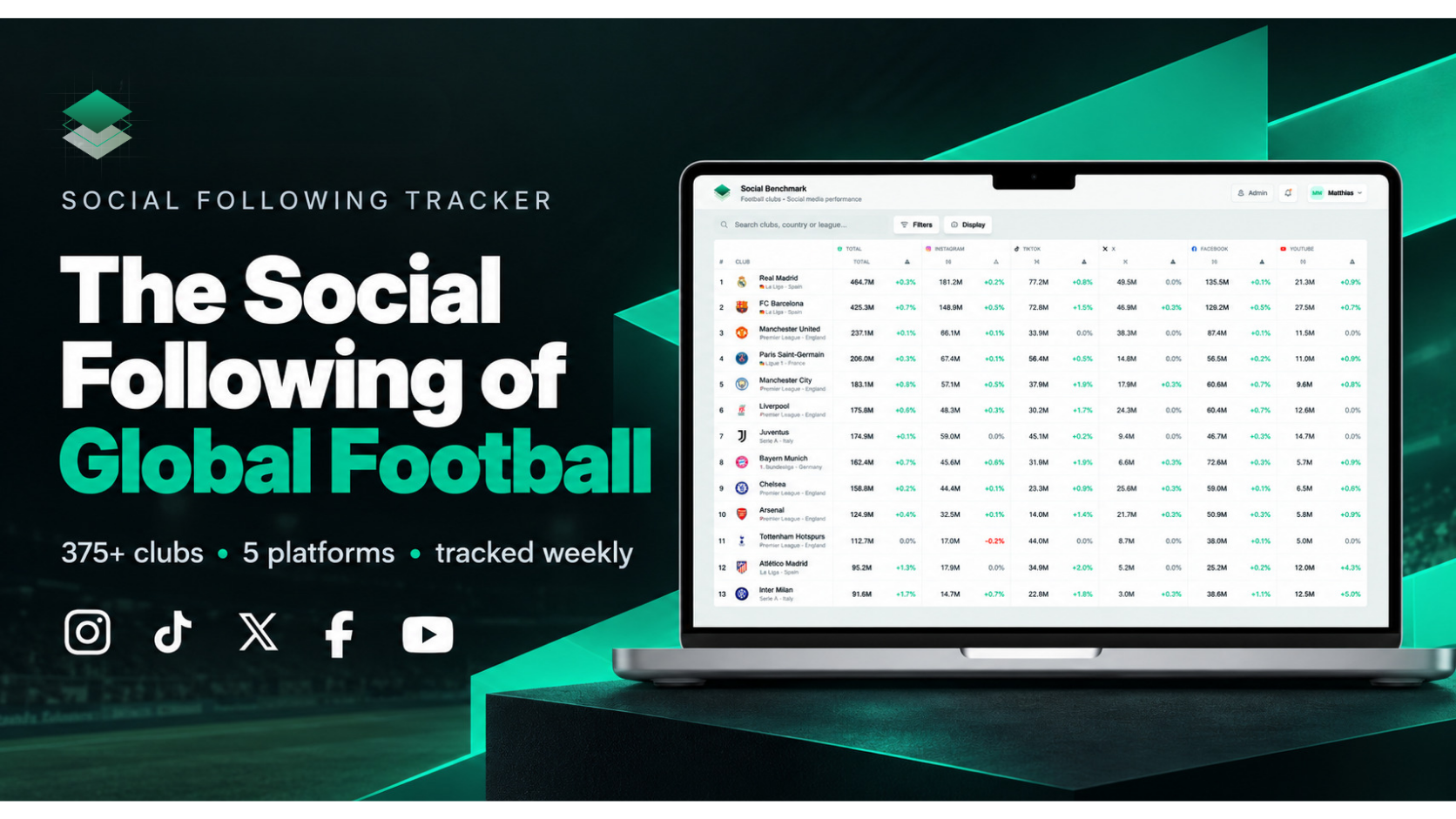
The Most Followed Football Clubs on Social Media
Reading time:
7 min


Sports organisations have more fan data than ever.
But knowing what fans do is not the same as understanding why they do it.
In this conversation, Tristan Farron-Mahon, Head of Sports Insight & Innovation at Simpson Carpenter, explains why the future of fan growth depends on combining behavioural data with deeper human insight.
From AI-powered qualitative research to sponsorship valuation and emotionally relevant fan experiences, this interview explores why depth, context, and meaning are becoming commercial advantages in sport.

Quantitative behavioural data is great at telling us ‘what’ is happening, but it cannot tell us ‘why’ it is happening. This ‘what’ is essential, it allows us to capture, measure, and validate key customer strategy drivers through various solutions at scale. However, without meaning and context behind the numbers, customer data is prone to being misinterpreted or misused to fit the narrative of a top-down decision-making process.
When it comes to fan understanding, we need to be able to capture the full human experience, to dive into and explore the complexities of human emotions, attitudes, and factors that influence behaviours and drive decision-making. This is where qualitative research comes in, to build on and complement quantitative research at a human level in a way that strengthens fan relationships specific to each unique sport, market, and fan context. This approach allows us to look explore and uncover fans unmet needs, pain points, gaps, and opportunities in real-life scenarios; or to look to the future and co-create or ideate new innovations that future-proof strategy not just for, but together with customers.
Applying this to a real-life example, the most repetitive scenario I see in the sports industry is over-dependence on syndicated and panel data as a driver for top-down decision-making across rights holders, clubs, and federations alike. Ignoring all the well-publicised issues with the validity behind panel data (bots, ‘professional’ respondents, design bias, selection bias etc.), sports fandom is fundamentally irrational, emotional, and highly contextual – none of which can captured via the standardised consumer logic this method utilises. This often leads to ‘behavioural’ data being used across the industry as evidence to support pre-determined strategic decisions that are determined by flawed customer knowledge.
Relying on quantitative behavioural data alone is a shortcut to ‘customer insight’ that undermines the sustainable competitive advantage sports properties can generate from genuinely understanding the deep, rich, emotionally relevant human truths that define their fans and target fan groups. Instead, the industry has a unique opportunity to complement their existing high-level fan data with a depth of consumer understanding that results in fan-led breakthroughs, by uncovering the currently unknown insights required to unlock true potential growth.
With competition for attention intensifying and fan expectations constantly evolving, sports properties’ commercial success hinges not just on collecting more hard data, but on understanding and connecting with fans at a much deeper level. Traditional panel data and surface-level metrics provide a baseline, but they are not enough. To build meaningful, sustainable commercial growth, sports businesses must look beyond the numbers and embrace the contextual and often complex truths that will help them build stronger and more valuable relationships with fans.
For years, the industry has celebrated volume: more data points, more tracking, more measurement. But the next wave of growth will come from depth, not breadth, and this is where tools like Quasai play a role in getting to that depth, without sacrificing speed and value.
For Simpson Carpenter, Quasai came from a desire to amplify research depth, expertise, and value rather than replace real customer interactions – it’s the closest we can get to human connection, with the advantages of AI. We harness its power to unlock richer human insights, accelerate analysis, and reveal patterns that traditional methods alone can’t reach. It allows us to run qual-at-scale (thousands) and engage fans at a deeper level, capturing instinctive, honest responses that improve the rightsholder-fan relationship.
In addition, more challenging topics and issues that remain in sport (e.g., racism and misogyny) can also be explored with more rigour than ever before as our bespoke Avatars create a sense of affinity and anonymity that ensures participants share deeper thoughts and behaviours without feeling judged by a human moderator. As sport is a global phenomenon, it’s ability to moderate in 50+ languages simultaneously without any additional costs or timing delays makes it hyper relevant for international or multi-market research. It can also be deployed flexibly according to client needs, including in-stadia booths or at-home interviews via QR code – or seamlessly paired with quant surveys to further support qual/quant data capture and integration.
Tools like Quasai show that AI can be used to gather richer narratives and deep emotional insight at scale in a way that overcomes existing cost, time, language, and quality barriers – creating added value for sports properties without removing research, advisory, and consultancy expertise.
It already is, and has been for many years – often deeply embedded into global or regional customer insight programmes in the same way their core operational and strategic functions are. Most brands that invest in sports sponsorship recognise the potential impact these partnerships have on their global brand equity. Therefore, they are taking an increasingly nuanced and selective approach to investment, utilising internal qualitative customer insight programmes to inform brand fit, valuation, and strategy before any decisions are made, in-partnership, and even post-relationship. Brands hold a very different value expectation now than they did 10 years ago - today, almost all forms of sponsorship must demonstrate clear ROI built on stronger understanding of customer value, requiring a mix of high-level quant metrics blended with qual depth and meaning.
I have been lucky enough to work with some of sports most prominent global sponsors, delivering the customer insights that guide partnership exploration, support valuation, influence activation, and track impact on brand equity. My key takeaway is that brands are much better prepared than rights holders with a depth of customer knowledge that helps them effectively pull extra value from almost any given sports partnerships. Brands know the impact that sponsorship will have on customer loyalty and retention, acquisition, future brand value, regional and global reputation….and much more. And they know exactly what they will get from rights holders - if done in the right way with the right cultural fit, they receive access to a primed audience base, unparalleled brand exposure, and cultural credibility often well beyond any value they can achieve through other marketing means.
For rights holders, it’s about levelling that playing field – by capturing deeper customer insight to strengthen commercial valuation, identify true partnership alignment, and showcase authentic relevance in a crowded market. Sport transcends borders, cultures, and communities. It spans its own sub-cultures and binds (or splits!) families, communities, towns, and even nations. Brands have long recognised this unique power that the right partnership has to boost awareness and association, forge emotional resonance, and shift brand perception with key audiences.
Yet, despite its immense social, cultural, and economic significance, the sports industry remains notoriously insular and slow to change. Too many sports properties do not fully realise the value of their own brand or customer base, and how that can be used to drive differentiation in what is largely a uniform market within each specific sport.
When human understanding, truths, and experiences are used to inform commercial strategy, not only will sports properties and partner brands achieve greater mutual value, but fans will also benefit from a ‘product’ that feels more personal, meaningful, and emotionally rich. This is an opportunity for rights holders to move from passive growth to actively harnessing fan understanding as a commercial advantage.
This interview sits right at the intersection of two topics I care about a lot:
Data-driven decision-making and human understanding.
For years, the sports industry has been told to collect more data. More tracking. More dashboards. More CRM data. More fan profiles. More segmentation. More measurement.
And to be clear, all of that matters.
Without strong quantitative data, clubs are guessing. They do not know who buys, who attends, who renews, who churns, who engages, who ignores campaigns, or which commercial activities actually move the needle.
But Tristan’s core point is important:
Behavioural fan data tells you what is happening.
It does not automatically tell you why it is happening.
That distinction is massive.
A fan may stop attending matches.
A member may not renew.
A campaign may underperform.
A sponsor activation may fall flat.
A target audience may not behave as expected.
The dashboard can show the movement.
But without context, motivation, emotion, culture, identity, and real-life fan experience, the interpretation can still be completely wrong.
This is where I think a lot of clubs get into trouble.
They do not lack data.
They lack depth.
They build reports around behaviour, but they often do not understand the emotional reality behind that behaviour. And because sports fandom is deeply irrational, social, emotional, cultural, and contextual, that gap matters even more than in many other industries.
A football supporter is not just a customer.
They are a fan, a member, a parent, a child, a local, an away traveller, a casual follower, a lifelong believer, a critic, a community member, and sometimes all of those at once.
Trying to understand that through surface-level metrics alone is risky.
Tristan makes this point very clearly when he talks about the over-dependence on syndicated data, panel data, and standardised consumer logic. In many cases, that type of data gets used to support decisions that have already been made.
That is not insight.
That is validation theatre.
And it is very close to the problem we often see in CRM, analytics, and commercial strategy:
A club has a hypothesis.
Then it looks for data to confirm it.
Then it calls the result customer insight.
Real fan insight should do the opposite.
It should reveal unmet needs, pain points, hidden motivations, cultural tensions, emotional triggers, and future opportunities that the organisation did not already know.
That is why I found Tristan’s perspective on AI-powered qualitative insight particularly interesting.
Usually, when people talk about AI in sports, they jump straight to automation, prediction, campaign optimisation, or content generation.
But Simpson Carpenter’s work with Quasai points to a different use case:
Using AI to scale depth.
Not replacing human understanding.
Amplifying it.
That is a very different framing.
Traditional qualitative research can be rich, but it is often slow, expensive, limited in sample size, and hard to scale across markets. Standard surveys can scale, but they often lose nuance, honesty, emotion, and context.
The promise of AI-powered qualitative research is that it can help close that gap.
Qualitative insight at scale.
Thousands of deeper conversations.
Faster analysis.
More honest responses.
Multi-market research across 50+ languages.
Flexible deployment through QR codes, at-home interviews, in-stadium booths, or combined qual and quant research.
That has serious implications for sports business.
It can help clubs understand why fans buy, why they churn, why they engage, why they reject offers, why they connect emotionally with certain moments, and why certain experiences matter more than others.
For CRM and fan engagement, that is incredibly valuable.
Because better fan engagement is not just about sending the right offer at the right time.
It is about understanding what the offer actually means to the person receiving it.
That is where the combination of quantitative fan data and qualitative fan insight becomes powerful.
Quantitative data helps clubs identify patterns:
Who is likely to renew.
Who is drifting.
Who buys merchandise.
Who responds to ticket offers.
Which audiences are growing.
Which campaigns drive conversion.
Qualitative insight helps explain the meaning behind those patterns:
Why fans feel attached.
Why they feel ignored.
Why certain matchday experiences matter.
Why a sponsor feels authentic or forced.
Why a product resonates.
Why younger audiences engage differently.
Why cultural context changes everything.
Together, they create a much stronger commercial intelligence system.
And that is why this topic fits so well with CRM, fan data strategy, sponsorship strategy, audience segmentation, customer insight, sports marketing, and revenue growth in football.
The sponsorship angle in the interview is especially important.
Tristan points out that brands are often much better prepared than rights holders. Many sponsors already use deep customer insight to evaluate fit, assess value, plan activation, and measure impact on brand equity.
That creates an imbalance.
Sponsors understand what they want from sport.
But many clubs do not fully understand the value of their own audience.
That is a problem.
Because if a club cannot clearly explain the emotional, cultural, behavioural, and commercial value of its fan base, it will struggle to defend pricing, differentiate from competitors, and build genuinely valuable partnerships.
Deep fan insight changes that.
It allows rights holders to move beyond reach, impressions, and generic demographic claims.
Instead, they can show:
What their audience cares about.
Why certain brands fit.
Which fan communities are most relevant.
How sponsorship can create emotional resonance.
Where activation should happen.
How partnerships can support loyalty, acquisition, retention, and brand perception.
That is a much stronger position.
And it is also better for fans.
Because the best sponsorships should not feel like a logo slapped onto attention.
They should feel relevant, useful, and culturally aligned.
That only happens when commercial strategy is informed by real human understanding.
For me, the big takeaway is this:
The next competitive advantage in sports will not come from data volume alone.
It will come from combining behavioural intelligence with emotional intelligence.
More data is not enough.
Better fan understanding is the unlock.
And tools like Quasai show where the industry may be heading: faster, deeper, more scalable insight that helps sports organisations understand not only what fans do, but what those behaviours actually mean.
That is exactly the kind of shift football needs.
Less assumption.
Less generic segmentation.
Less “we know our fans” without evidence.
More context.
More depth.
More honest insight.
More fan-led strategy.
Because fan growth, sponsorship valuation, CRM performance, ticketing strategy, merchandise growth, retention, brand building, and long-term commercial development all depend on the same foundation:
Understanding people properly.
Not just as data points.
As fans.