Most Clubs Have Reach. Few Turn It Into Revenue. Introducing Reach-to-Revenue.


TL;DR: Your club already has the fans. The missing piece is turning that reach into predictable digital revenue. Reach-to-Revenue is the program that does exactly that: a structured, joint initiative from Unidy, FBIN, and High Block that benchmarks where your club stands, fixes the leaks in your funnel, and ships the work. It is built for professional clubs of any size that want the reach they have to start counting on the balance sheet.
The quiet gap most clubs don't see
Walk through any professional football club's commercial setup. The stadium is full. The social channels have followers. The mailing list is long. Every visible metric suggests the reach is real, and yet, the revenue that attention should produce never quite shows up in the numbers.
This isn't a failure of effort. It is a structural gap. The same fan is recognized in the ticketing system, anonymous in the shop, and a different person again on the app. Reach is everywhere. Activation is nowhere.
Deloitte research, cited by FT Strategies, finds that engaged fans spend roughly six times more than casual fans. That gap between an uncontactable follower and an activated, recurring buyer is where the money either compounds or quietly disappears.
Most clubs are sitting in that gap right now without realizing it.
Why the gap is so common
Four leaks sit in nearly every club funnel:
- Unowned audience. Followers, ticket buyers, and website visitors leave before they become known, contactable fans. The club has reach but doesn't own it.
- Fragmented identity. Fan profiles stay split across ticketing, shop, app, membership, and sponsor systems. The club knows the segments, not the fan.
- Manual activation. Campaigns depend on exports, one-off lists, and individual know-how. Nothing compounds.
- Weak commercial proof. Revenue impact and sponsor value stay hard to demonstrate, which keeps investment small.
Each leak costs something measurable. None of them get fixed by adding another dashboard, hiring one more vendor, or commissioning another strategy deck. They get fixed by closing the chain end to end.
What Reach-to-Revenue actually does
Reach-to-Revenue is a structured program that closes that chain. It turns reach into revenue through a defined process: benchmark where the club stands, identify the highest-value leaks, fix them in the right order, and prove the result.
Three things make it different from what most clubs have tried:
- It starts with reality, not ambition. The entry point is a diagnostic that scores the club's digital revenue readiness against comparable peers. No theory, no slide deck, just where the club actually sits. 2. It fixes what matters first. Every recommendation is ranked by revenue impact, not by what is easiest or most fashionable. The club gets a prioritized list, not a backlog. 3. It ships the work. The same team that diagnoses the problem can execute the fix. No hand-off to another vendor, no plan gathering dust.
It is built for professional clubs of any size, from second-division sides looking to professionalize their commercial function to top-flight clubs that know the data exists but can't seem to get it moving. The maturity level changes, the program shape doesn't.
Already conviced?
Check it out yourself: https://reach-to-revenue.com/
Who delivers it
Reach-to-Revenue is a joint initiative between three operators, each owning a distinct piece of the chain:
- Unidy brings the fan-identity and consent infrastructure. Jan-Georg Streletzki, CEO and Founder of Unidy, has spent more than a decade helping sports organizations collect and own their fan data, turning scattered logins, shops, and ticketing systems into a single fan identity that holds up under GDPR.
- FBIN (Football Business Inside) brings the club-business expertise, the operator network, and the program framing through Club Growth that lets the work actually land inside a real club.
- High Block brings the CRM, segmentation, and activation execution that turns identified fan data into engagement, sponsorship value, and recurring revenue. Matthias Werner of High Block focuses on the systems that actually move tickets, merchandise, and sponsor reporting.
Each operator on their own solves a fraction of the problem. Together, they cover the chain end to end, which is why Reach-to-Revenue exists as a single program rather than a set of disconnected services.
Thomas Maurer, Managing Director at FBIN, puts it plainly:
"Not much of this is new to football; the pieces already exist. What's usually missing is someone to put them together and see them through. That's the gap we're trying to fill."
Jan-Georg Streletzki, CEO at Unidy, frames it from the data side:
"For a lot of clubs, the data is already there, just spread across systems that don't speak to each other. Bring it together, and the reach finally starts to count for something."
How the program works
Reach-to-Revenue is built as a progressive journey. Clubs start where the gap is sharpest and decide how far they want to go.
Most clubs begin with a one-time diagnostic that produces a concrete readiness score, a funnel baseline, and a prioritized action list. From there, the program offers two optional paths: an ongoing monthly rhythm that keeps the work moving, and on-demand execution sprints that ship the actual fixes.
The maturity model behind it
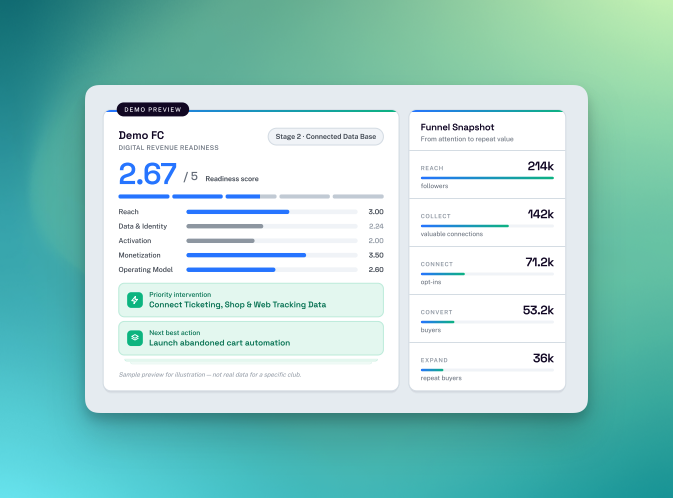
Reach-to-Revenue is built on a six-stage digital revenue maturity model. Most clubs sit between stages two and four. Where a club sits on the model tells the team which milestones unlock the next level.
1) Unstructured Outreach
2) Connected Data Base
3) Unified Fan Platform
4) Structured Activation Engine
5) Revenue-Driven System
6) Integrated Revenue Ecosystem
The overall readiness score breaks down into five dimensions: Reach, Data & Identity, Activation & Campaigning, Monetization & Revenue, and Operating Model. A club can be strong on one dimension and weak on another, which is exactly what makes the score useful. It shows where value is breaking. Where the system is busy does not always mean the system is working.
The accompanying funnel snapshot tracks five stages from audience attention to repeat commercial value: Reach, Collect, Connect, Convert, Expand. Each stage carries example volumes and a commercial value per contact, so the club sees exactly where audience stops converting into owned, contactable, revenue-generating fans.
Why clubs that ignore this lose ground
The cost of doing nothing isn't zero. Every season that passes without closing the funnel gap is a season where another club, somewhere, gets better at converting the same kind of fan. Reach compounds. Activation compounds faster. The gap between clubs that run this well and clubs that don't widens quietly, then visibly, then structurally.
Reach-to-Revenue exists for clubs that want to be on the right side of that line.
How to start
The first step is a conversation about where the club stands today. For clubs that want a quick preview before committing, a public demo assessment shows what the score, findings, revenue gaps, and priority actions look like in a finished report.
For clubs ready to go, the diagnostic is the entry point. The rest is optional.
Frequently Asked Questions
What is Reach-to-Revenue?
Reach-to-Revenue is a structured program for professional football clubs that turns existing fan reach into measurable digital revenue. It is the first track inside FBIN Club Growth and is delivered as a joint initiative between Unidy, FBIN, and High Block.
Who is Reach-to-Revenue for?
It is built for professional clubs of any size that already have reach, fan activity, and commercial ambition, but are not yet turning that attention into repeatable, measurable digital revenue. It fits clubs that want an external team to do the work, whether because internal capacity is limited or because the existing approach isn't moving the needle.
What does the program actually deliver?
Every club starts with a diagnostic: a Digital Revenue Readiness Score, a funnel baseline, a maturity stage with milestones, and a prioritized action list. From there, clubs can choose to add ongoing advisory support, on-demand execution sprints, or both. The point is to ship the work, not just describe it.
How is Reach-to-Revenue different from a CRM audit?
It is not an audit. It produces a concrete readiness score, a funnel baseline, a maturity stage, and a prioritized execution list with revenue upside where the data supports it. The report is interactive, shareable, and exportable, and every input that produced the score remains visible. Most importantly, the same team that diagnoses the problem can fix it.
What kind of revenue impact is realistic?
Engaged fans spend roughly six times more than casual fans (Deloitte research, cited by FT Strategies). The actual uplift depends on where the club starts and which leaks get closed first. Where the data allows, selected actions include transparent revenue upside ranges with the assumptions behind them.
Who delivers the program?
Reach-to-Revenue is delivered jointly by Unidy (fan identity and consent), FBIN (club-business expertise and program framing through Club Growth), and High Block (CRM, activation, and revenue execution). Jan-Georg Streletzki leads Club Growth as FBIN partner. Matthias Werner leads the CRM and revenue layer on the High Block side.
What does it cost?
Pricing is agreed per club based on size, scope, and starting point. The diagnostic that most clubs start with is structured to be self-funding if the club continues with the next stage.


