






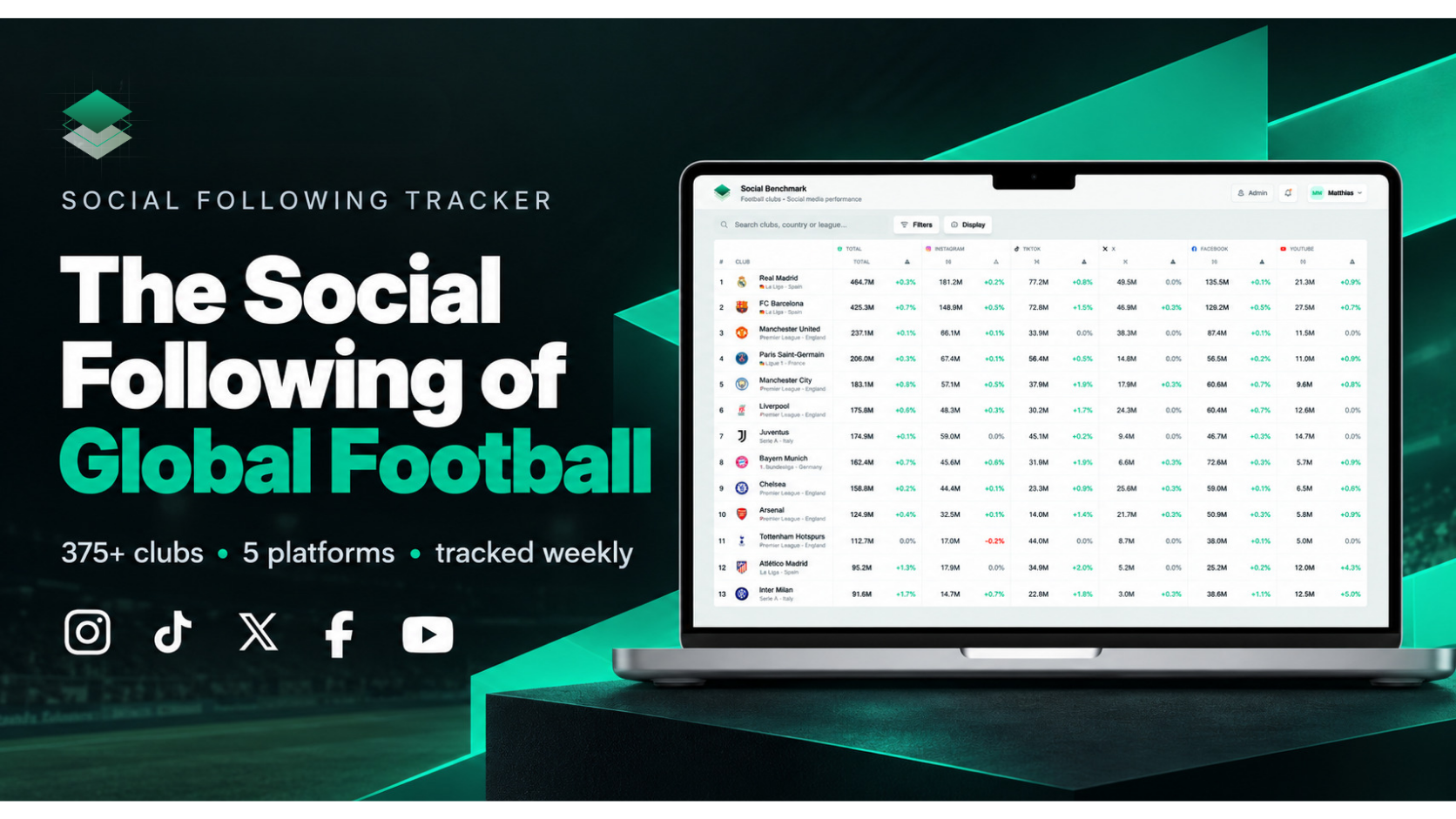
The Most Followed Football Clubs on Social Media
Reading time:
7 min


Football analytics is no longer a niche topic. Metrics like xG are now part of mainstream football language.
But models are only useful when people understand what they can and cannot explain.
In this conversation, Alex Marin Felices breaks down how xG fits into a larger decision-making framework, why the next analytics frontier is everything before the shot, and why context may be the most underutilized signal in football data today.
Clearly, the goal is not more numbers anymore but better decisions.

I think models like xG are best viewed as tools that help reduce uncertainty rather than eliminate it.
Inside professional clubs, decisions are never made from a single number. xG is one piece of evidence within a broader process that also includes video, tactical analysis, scouting observations, and domain expertise. Its value is that it provides an objective way to evaluate chance quality and separate performance from short-term outcomes.
At the same time, every model is a simplification. xG captures an important aspect of football, but it doesn’t capture everything. The key is understanding both what a model measures and what it doesn’t.
Ultimately, the best clubs don’t use analytics to replace judgement. They use it to challenge assumptions, improve discussions, and make more informed decisions. The model itself is rarely the goal; better decisions are.
If xG helped football understand the quality of the chances created, I think the next step is understanding everything that happens before the shot.
Concepts such as Expected Threat (xT), and other action valuation models are already moving in that direction by attempting to measure how players contribute to creating future opportunities rather than simply taking the final action. They allow us to better value progression, decision-making, and contributions that traditional statistics often miss.
I also believe we’ll see growing interest in off-ball behaviour and decision quality. As tracking data becomes more accessible, clubs are increasingly trying to quantify positioning, movement, space creation, and the decisions players make throughout a possession, and without the ball.
The challenge in this case will be translating these complex concepts into something coaches, players, broadcasters, and fans can understand as intuitively as they now understand xG.
I think the most underutilized resource in football analytics is context.
We have access to more data than ever before (event data, tracking data, physical data, …) but understanding why something happened is often more valuable than simply measuring what happened. Context includes tactical roles, game states, player interactions, defensive pressure, fatigue, and many of the factors that shape decision-making on and off the pitch.
Tracking data is particularly exciting because it gives us access to many of these hidden layers, especially off-ball behaviour, positioning, and team structure.
As for what separates clubs, I don’t think it’s access to data anymore. Most professional clubs have access to similar information.
The difference lies in how clearly they define the problems they want to solve, how effectively they integrate analytics into existing workflows, and how well they connect data, football expertise, and decision-making. The best clubs are not necessarily those with the most sophisticated models, but those that consistently turn information into action.
This interview is a great reminder that good analytics is not about worshipping models.
It is about improving decisions.
That distinction matters a lot in football.
Because the industry has moved quickly from “analytics is niche” to a world where xG is now shown on broadcasts, used in post-match debates, referenced by fans, and discussed by pundits.
That is progress.
But it also creates a new risk.
When a metric becomes mainstream, people often start treating it as more definitive than it really is.
Alex’s framing is spot on here:
xG helps reduce uncertainty.
It does not eliminate it.
That might be one of the most important sentences in modern football analytics.
Inside a professional club, no serious decision should be made from one number. xG can tell you something valuable about chance quality. It can help separate performance from short-term finishing variance. It can challenge lazy narratives after a match.
But it does not explain everything.
It does not fully capture tactical intent.
It does not capture every player interaction.
It does not capture emotional momentum.
It does not capture all context around pressure, fatigue, role, movement, or game state.
And that is exactly why the best clubs do not use analytics to replace judgement.
They use analytics to challenge assumptions, improve internal discussions, and make better-informed decisions.
That is the healthy role of models in football.
Not “the model says so.”
More like:
“What does the model see that we might be missing?”
This connects perfectly to the broader theme I keep coming back to in CRM, fan data, and commercial systems as well.
Data only creates value when it changes decisions.
A dashboard that confirms what people already believe is not intelligence.
A metric that sparks a better conversation is useful.
A model that reveals a blind spot is useful.
A signal that helps a club act earlier, smarter, or with more confidence is useful.
Everything else is decoration.
What I also found interesting is Alex’s view on where football analytics goes next.
If xG helped football understand the quality of shots, the next step is understanding everything that happens before the shot.
That is where concepts like Expected Threat, xT, action valuation models, possession value, progression metrics, decision quality, and off-ball behaviour become increasingly important.
This is the natural evolution.
Football is not just about the final action.
A player can create value by receiving between lines.
By moving a defender.
By opening space.
By progressing the ball.
By choosing the right pass.
By making a run that never gets rewarded.
By positioning in a way that stabilizes the team.
Traditional statistics often miss that.
Even xG, useful as it is, starts late in the chain.
The more interesting question is:
How did the team arrive there?
That is why tracking data is so exciting.
It gives clubs access to hidden layers of the game: spacing, team structure, defensive pressure, off-ball movement, player orientation, compactness, passing options, and the decisions available before the obvious event happens.
For football clubs, this is where the next competitive advantage in performance analysis, recruitment analytics, tactical analysis, player profiling, and squad planning will likely emerge.
But there is a challenge.
The more advanced the metric, the harder it becomes to communicate.
xG became mainstream because it is relatively intuitive.
A shot had a certain probability of becoming a goal.
People can understand that.
But Expected Threat, off-ball value, action valuation, and decision quality are harder to explain. They require stronger translation between analysts, coaches, players, sporting directors, media, and fans.
That translation layer matters.
A great model that nobody understands will not influence decisions.
A slightly simpler model that improves shared understanding might create more impact.
This is one of the most underrated skills in football analytics: communication.
Not just building the model.
Explaining what it means.
Explaining what it does not mean.
Explaining where it should influence the conversation.
Explaining where football expertise still needs to interpret the signal.
Alex’s third answer brings this together nicely.
The most underutilized resource in football analytics is context.
That is a powerful point.
Because most clubs now have access to similar data types.
Event data.
Tracking data.
Physical data.
Video.
Scouting reports.
Performance platforms.
Access is no longer the differentiator it once was.
The differentiator is how well a club understands the problem it wants to solve, integrates analytics into existing workflows, and connects data with football expertise.
This is where many organizations still fall short.
They collect more data without defining the decision they want to improve.
They build reports without embedding them into daily workflows.
They hire analysts but do not give them influence.
They create models but fail to connect them to coaching, recruitment, player development, or match preparation.
That is not a data problem.
It is an operating system problem.
The best clubs are not necessarily the ones with the most sophisticated models.
They are the clubs that consistently turn information into action.
That line should be printed on the wall of every football analytics department.
Because in the end, football data, xG, Expected Threat, tracking data, action valuation models, player analytics, recruitment intelligence, tactical analysis, performance data, and AI in football only matter if they help people make better decisions.
That is why this interview fits so well into my world.
Whether we talk about sporting performance or commercial operations, the principle is the same:
More data is not the answer by itself.
Better decision systems are.
In CRM, this means using fan data to improve segmentation, engagement, retention, sponsorship activation, and revenue growth.
In football analytics, it means using performance data to improve player evaluation, tactical understanding, recruitment, training, and match strategy.
Different departments. Same challenge.
Do not just collect more information.
Build the capability to interpret it, contextualize it, communicate it, and act on it.
That is the real edge.