






How to integrate vivenu ticketing data into Dotdigital
Reading time:
14 mins


Most clubs already have the audience.
The followers are there. The mailing list is there. The stadium fills up. But the revenue behind that reach often remains harder to capture.
In this conversation, Thomas Maurer, Managing Director at FBIN, introduces FBIN Club Growth and its first track, Reach-to-Revenue.
From Potential Analysis to Revenue Accelerator and Boost Projects, the idea is simple: help clubs find untapped commercial potential and turn it into execution, without building a full internal growth department.

That’s a very good question. And if it were easy to answer, clubs would have done so already. I think it’s often a combination of many factors, but a lack of manpower probably plays a role quite often. Or perhaps the topic can seem so overwhelming that it’s hard to find the right starting point. Maybe people also don’t believe in the potential or fear massive costs before they can actually start making money with their digital reach.
I think that with FBIN Club Growth, we can dispel all these fears and remove these barriers, without huge costs and without the club having to commit massive manpower right from the start.
You could change “not” to “much more than just.” Of course, we can handle strategy, too. But we do so much more than that. We actively participate in implementation (when needed) - we carry out projects independently for clubs or in collaboration with them. That’s how we help the club lay the groundwork for generating revenue. And the club can then follow through, by investing additional manpower, for example.
FBIN Club Growth is ideal for small and medium-sized clubs. Very large clubs often have enough manpower to develop internal solutions. But even for the largest clubs, an outside perspective is extremely important—and, of course, we can help with that as well. Having the status quo, the potential, and a comparison with other clubs laid out in black and white helps with future planning.
For small and medium-sized clubs, we can take over exactly the areas where they still have gaps. Often, certain processes are already working very well, and we supplement them, build on them, and take the next step together. Or we can completely rebuild and implement a digital monetization strategy from scratch. That’s possible, too.
In summary, every club is unique, and we find the best possible solution for every club, regardless of size.
This interview hits very close to the core of what I care about in football business.
Because the problem Thomas describes is everywhere.
Clubs have reach.
They have followers.
They have matchday attendance.
They have newsletter databases.
They have ticket buyers, shop customers, app users, hospitality guests, sponsors, and local communities.
On paper, that looks strong.
But the commercial result often does not match the attention.
That is the gap.
And it is one of the most important gaps in modern football business.
The reach is real.
The monetization is often not.
What I like about Thomas’ answer is that he does not pretend there is one simple reason. It is usually a mix.
Limited manpower.
Unclear starting points.
Fragmented systems.
Fear of costs.
Doubt about the potential.
And sometimes just the feeling that the whole topic is too big to touch.
That last point matters.
Because many clubs are not inactive because they lack ambition.
They are inactive because the path is not clear enough.
A club may know that digital reach matters.
It may know that fan data matters.
It may know that CRM, marketing automation, sponsorship reporting, and digital revenue streams are important.
But knowing something matters is different from knowing what to do next on Monday morning.
That is why I think the Club Growth concept is interesting.
It is not framed as another abstract strategy exercise.
Thomas even makes the distinction more precise:
It is much more than strategy.
Strategy is part of it, but the real value is in moving from clarity to implementation.
That is where a lot of football projects break.
A club gets a presentation.
Everyone nods.
The potential looks obvious.
The recommendations sound reasonable.
And then the plan slowly dies because nobody inside the club has the time, role, mandate, or technical capacity to push it through.
That is not a criticism of clubs.
It is the reality of lean teams.
Commercial departments inside many small and medium-sized professional clubs already have enough to do.
Ticketing.
Sponsorship.
Events.
Merchandise.
Hospitality.
Matchday operations.
Campaigns.
Partner requests.
Internal coordination.
Then someone says: "We should also build a data-driven growth engine."
Correct.
But who owns it?
Who connects the systems?
Who defines the fan data model?
Who builds the CRM logic?
Who turns reach into owned data?
Who turns owned data into campaigns?
Who connects that to sponsorship value?
Who reports on the funnel?
Who keeps the work moving after the first workshop?
That is exactly where Club Growth can make sense.
The model has a useful sequence.
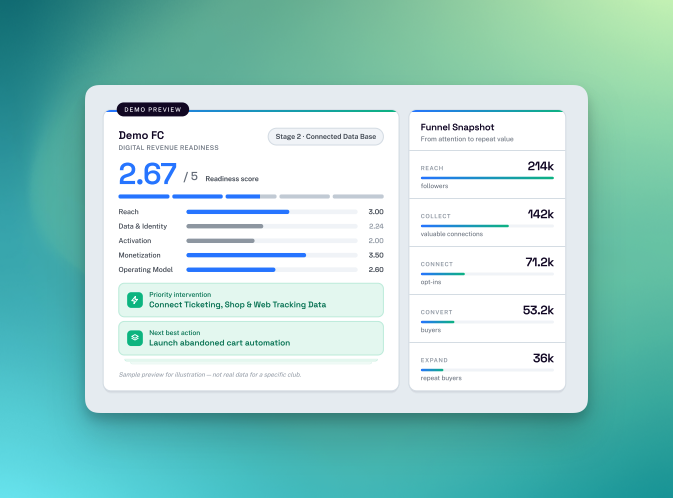
First, the Potential Analysis creates clarity. It benchmarks the club, makes potential visible, and turns a vague feeling into a short list of priorities.
Then the Revenue Accelerator keeps the work alive with data, KPI views, and regular reviews.
Then Boost Projects handle the actual execution, either together with the club or for the club.
That sequence matters.
Because many clubs do not need more theory.
They need a way to start.
Then a rhythm to continue.
Then enough execution capacity to actually ship things.
For me, the strongest part of the concept is the external growth team framing.
It recognizes a reality that many clubs face:
They need growth capabilities, but they cannot always hire a full growth department.
And even if they could, they might not know exactly which roles to hire first.
Fan identity.
CRM.
Marketing automation.
Commercial analytics.
Sponsorship activation.
Digital revenue.
Hospitality.
Data infrastructure.
Campaign execution.
These topics are connected, but they are rarely covered by one person inside a club.
So the external team model can reduce the barrier.
It gives clubs access to specialist capabilities without forcing them to build the whole structure internally from day one.
That is especially relevant for small and medium-sized clubs.
Very large clubs may already have internal teams, although even they can benefit from external perspective and benchmarking.
But for the clubs below that level, the fit is obvious.
They often have real fan bases, strong local relevance, and commercial ambition.
What they lack is capacity.
Or structure.
Or someone to connect the pieces.
And that is where Thomas’ framing becomes important:
Every club is unique.
Some already have good processes in place and need support in specific areas.
Others need a digital monetization strategy built from scratch.
Some need better data acquisition.
Some need CRM and campaign infrastructure.
Some need clearer sponsor value.
Some need to turn fragmented reach into owned, usable fan data.
There is no single template that fits every club.
But there is a repeatable logic:
Understand where the club stands.
Identify the most valuable gaps.
Prioritize what matters.
Build the missing pieces.
Keep moving until the work creates revenue.
That is why I think Reach-to-Revenue is a strong first track.
The phrase is simple, but the problem behind it is deep.
Turning reach into revenue means much more than growing social followers.
It means moving fans from anonymous attention into owned relationships.
It means connecting ticketing, shop, app, newsletter, CRM, and identity systems.
It means understanding where the audience actually lives.
It means building campaigns that can generate digital revenue beyond matchday.
It means giving sponsors better audience value, better activation options, and better reporting.
It means building the commercial operating system around the fan.
This is where keywords like football CRM, fan engagement, fan data, digital revenue, sponsorship value, marketing automation, club growth, revenue operations, fan identity, and data-driven football operations stop being buzzwords.
They become practical work.
And that is the point.
The pieces already exist in football.
The hard part is putting them together and seeing them through.
That is why this interview is a good introduction to Club Growth.
It does not overcomplicate the promise.
It starts with a very real observation:
Most clubs have more reach than they can currently monetize.
Then it introduces a model for closing that gap without asking clubs to build an entire department immediately.
And it leaves room for different levels of maturity.
A small club can start with a free Reach-to-Revenue Snapshot.
A more advanced club can use a Potential Analysis to benchmark its status quo and define priorities.
A club ready to act can move into implementation through the Revenue Accelerator and Boost Projects.
That range is important.
Because growth work in football cannot be built only for clubs that are already advanced.
The real opportunity is often with clubs that have ambition, reach, and community, but need help turning that into structured commercial action.
That is why I find Club Growth genuinely interesting.
It sits in the gap between strategy and execution.
Between reach and revenue.
Between fan attention and owned fan relationships.
Between commercial ambition and internal capacity.
And if that gap gets closed, clubs can stop treating digital growth as a future topic and start treating it as part of everyday commercial operations.