






The Most Followed Football Clubs on Social Media
Reading time:
7 min


Football clubs often have plenty of fan data.
The problem is that ticketing, membership, ecommerce, and app activity usually live in separate systems, creating multiple versions of the same person.
In this conversation, Keegan Longera from Customer.io explains what needs to come together before behaviour-based messaging can work, which signals clubs are using today, why deliverability matters more than many teams realise, and why season renewal reminders are often the smartest first use case.

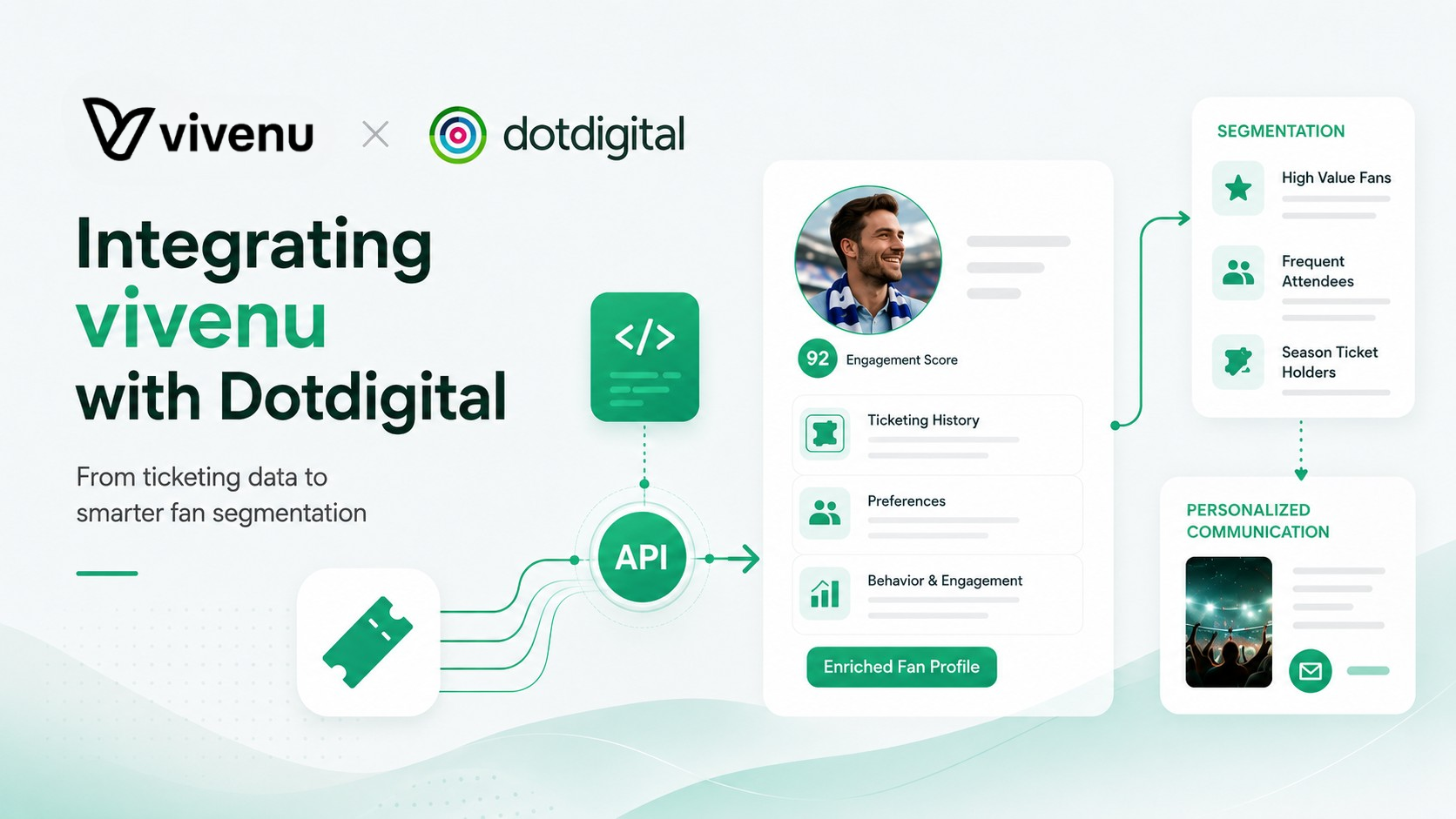
Before anything behaviour based works, you need one fan profile instead of four. Ticketing, membership, ecommerce and the app usually each hold their own version of the same person. The real unlock isn't a warehouse project, it's being able to pull that data together without six months of engineering, so marketing sees renewal dates, purchases and attendance as one picture instead of four separate exports.
Renewal windows and lapsed engagement are the two that move the needle most, someone approaching their season renewal date, or someone who hasn't opened anything or attended in a while. The signal only matters if the message actually lands though. It's easy to build a perfectly timed trigger that quietly never reaches the inbox because deliverability wasn't part of the setup. That's the unglamorous half of the job that tends to get skipped.
Season renewal reminders are usually the cleanest first win. Clear before and after, easy to measure, and low risk to start with. It also doesn't need to sit in a developer queue, a marketer can build that trigger themselves in plain language rather than filing a ticket and waiting weeks. Prove that one works and the case for expanding into more behaviour based sends tends to build itself.
This interview gets very close to one of the most common CRM problems I see in football.
Clubs usually do not suffer from a complete lack of fan data.
Quite the opposite.
They have ticketing data.
Membership data.
Merchandise purchases.
App activity.
Newsletter engagement.
Attendance.
Renewal dates.
Sometimes loyalty data as well.
The problem is that these signals often live in different systems and are handled by different teams.
So the same supporter can effectively exist as several different people.
One identity in the ticketing platform.
Another in the ecommerce shop.
Another in the app.
Another in the email system.
And this is where Keegan’s first answer really lands.
Before behaviour-based messaging can work properly, the club needs one usable view of the fan.
That does not necessarily mean spending six months building a giant data warehouse.
That distinction matters.
Too many clubs hear "single customer view" or "unified fan profile" and immediately picture a huge transformation project.
That can become a reason not to start.
The practical requirement is simpler:
Can marketing see the relevant behaviours in one place?
Can they understand that this fan bought a season ticket, attended twelve games, purchased merchandise, and has a renewal date coming up?
Can they act on that information without exporting four spreadsheets and stitching them together manually?
That is the level where CRM starts becoming useful.
For me, this is one of the biggest differences between having fan data and being able to activate fan data.
A database alone creates very little value.
The commercial value comes from being able to recognise behaviour and respond to it.
That is where behaviour-based messaging becomes interesting.
Instead of sending the same newsletter to everyone, the communication starts reacting to what the fan actually does.
Someone enters a renewal window.
Someone stops attending.
Someone has not engaged with email for several months.
Someone buys a specific product.
Someone joins the membership programme.
Those events can become useful signals.
But Keegan makes an important point that is easy to overlook:
The trigger can be perfect and still achieve nothing if the message never reaches the inbox.
Deliverability is not the glamorous part of CRM.
It is also one of the parts that can quietly destroy the value of everything built on top of it.
That is a useful reminder.
We often talk about segmentation, personalisation, automation, AI, customer journeys, and behavioural triggers.
But basic execution quality still matters.
If domain reputation is poor, consent is unclear, lists are unhealthy, or the technical setup is weak, sophisticated CRM logic will not rescue the campaign.
The message has to arrive.
Then it has to be relevant.
Only then can it influence behaviour.
I also like the signals Keegan mentions because they are commercially meaningful and easy to understand.
Renewal windows.
Lapsed engagement.
Neither requires exotic predictive modelling.
A season ticket holder approaching renewal is an obvious moment of intent.
A previously active supporter who suddenly stops attending or engaging is another.
The club already knows something changed.
The opportunity is to respond while the signal is still useful.
That sounds obvious, but many football organisations still operate mainly through campaign calendars.
Tuesday newsletter.
Friday matchday mail.
Merchandise promotion.
Ticket push.
Sponsor campaign.
Everyone receives roughly the same communication because the organisation is built around campaigns rather than fan behaviour.
Behaviour-based CRM flips that logic.
The fan action becomes the starting point.
That is a much more interesting way to think about fan engagement.
And it is where connected fan data starts producing practical commercial value.
The third answer is probably my favourite because it tackles another recurring problem:
Where do you start?
Season renewal reminders are a very good example.
They are measurable.
The timing is clear.
The audience is defined.
The commercial outcome is obvious.
And there is relatively little risk.
That makes them a perfect CRM use case for clubs that want to move from generic communication toward marketing automation and behavioural messaging.
You do not need to redesign the entire fan journey.
You do not need fifty automations.
You do not need an AI recommendation engine.
Build one useful trigger.
Measure the result.
Compare it with the previous process.
Then expand.
That approach fits strongly with how I think CRM projects should work in football.
Start with a business problem.
Build the smallest useful system around it.
Measure whether it works.
Then increase sophistication.
This is especially important for professional football clubs with lean commercial and marketing teams.
They cannot afford to spend months building infrastructure before seeing value.
The first use case has to create confidence internally.
Once a marketing team can show that an automated renewal journey improves conversion, saves manual work, or reaches supporters at a better moment, the conversation changes.
CRM stops being an abstract technology investment.
It becomes a revenue tool.
That internal proof is incredibly valuable.
It helps justify better data integration.
It creates appetite for more automation.
It makes investment in fan identity, segmentation, and first-party data easier to defend.
And it gives the marketing team evidence that behavioural communication works.
There is also an important operational point in Keegan’s answer.
Marketers should not need to wait weeks for a developer every time they want to test a trigger.
That is a major constraint in many organisations.
If every automation requires a technical ticket, CRM becomes slow.
If the marketing team can build and adjust journeys themselves, the feedback loop gets much shorter.
That is where flexible customer data platforms and modern marketing automation tools can create real leverage.
The technology matters, but mainly because it changes what the team is able to do.
This is also why flexibility in the underlying data model matters so much in football.
Football clubs have unusually fragmented commercial ecosystems.
Ticketing providers.
Ecommerce platforms.
Membership systems.
Mobile apps.
Access control.
Loyalty solutions.
Hospitality systems.
External matchday vendors.
Email platforms.
CRM.
Each system may produce useful fan behaviour.
The challenge is getting enough of those events into a common environment where marketing can act on them.
That is the foundation for a modern football CRM strategy.
One fan profile.
Useful behavioural events.
Reliable message delivery.
Clear commercial use cases.
Marketing teams that can execute without constant technical dependency.
None of those ideas are particularly flashy.
That is probably why I like them.
They are practical.
And they address the gap between the fan data clubs already collect and the personalised fan engagement they often say they want.
For me, the biggest takeaway from Keegan’s answers is simple:
Do not start with complexity.
Start by connecting enough data to understand one useful behaviour.
Then respond to it well.
A renewal reminder today can become lapsed-fan recovery, personalised ticketing journeys, merchandise recommendations, membership activation, sponsor campaigns, and more advanced lifecycle marketing tomorrow.
That is how football clubs can move from disconnected customer data toward behaviour-based CRM, marketing automation, stronger fan engagement, and ultimately more digital revenue.