Fan Retention: How Football Clubs Keep Their Fans


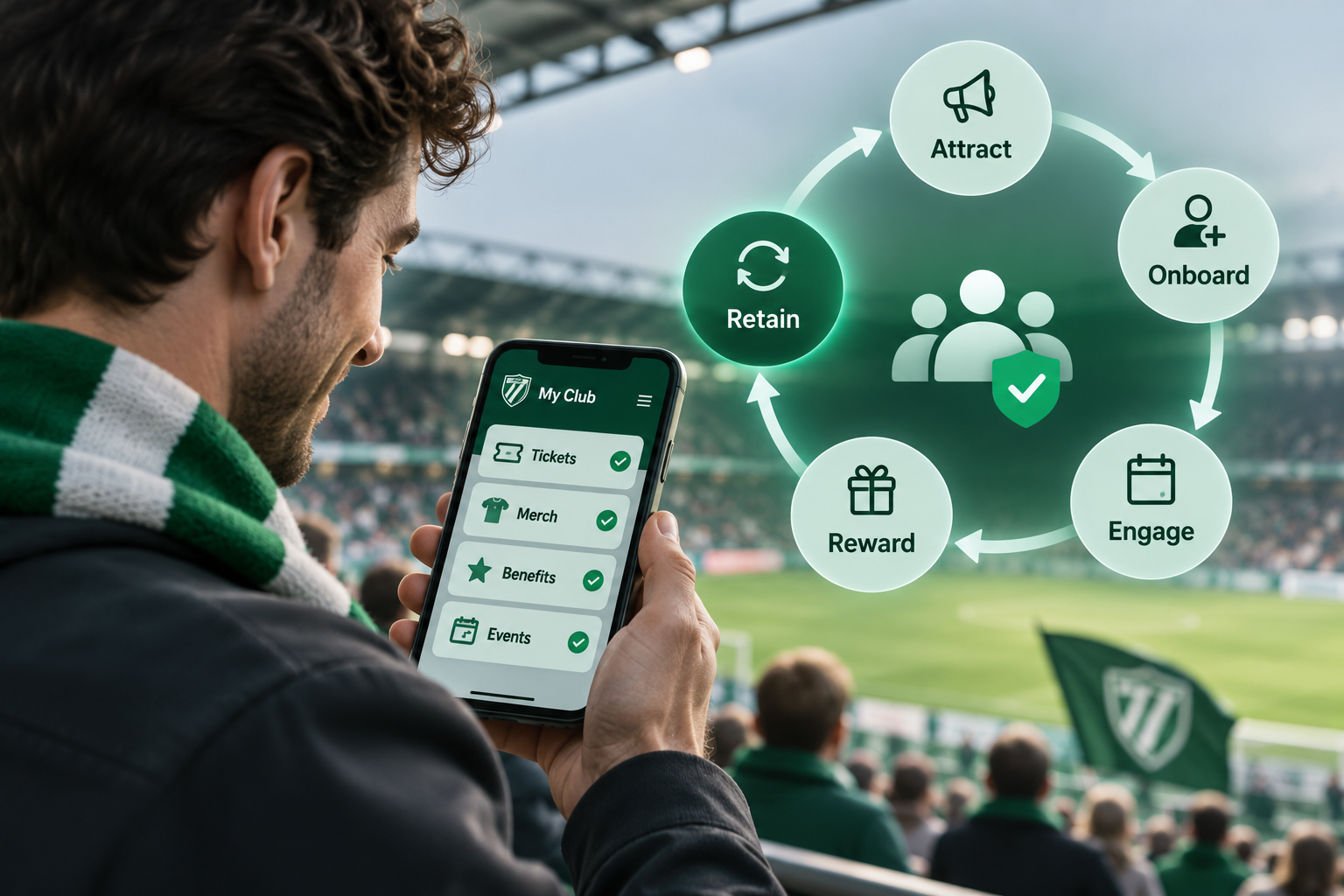
TL;DR: Football clubs spend most of their marketing budget finding new fans while the fans they already have quietly drift away. Fan retention is the discipline of keeping existing supporters active, and it is measurable: a short list of lag measures (renewal rate, active-fan share) steered by lead measures you can influence every week. This guide gives you a retention scorecard, the churn signals already sitting in your ticketing and CRM data, segment-specific levers, and the arithmetic that shows what a single point of retention is worth.
What fan retention means for a football club
Fan retention is the discipline of keeping supporters who already have a relationship with your club actively connected to it, measured by how many of them stay engaged, renew, and buy again from one season to the next.
That definition matters because most clubs answer a different question. Ask "how do we keep fans?" in a marketing meeting and the conversation slides into reach, content calendars, and follower counts. Those things fill the top of the funnel. Retention happens after it: the season ticket holder deciding in March whether to renew, the member weighing up a second year, the casual fan who came twice last season and hasn't thought about your club since September.
I build CRM and fan-data systems for professional football clubs, and the pattern is remarkably consistent. Ticketing, merchandise, and email data sit in three different systems. Each one holds a partial answer to "who is still with us?" Because the answers never meet in one place, clubs discover churn as an aftermath: the renewal report lands, the number is lower than hoped, and everyone stares at a result that was decided months earlier somewhere in the data.
The commercial logic is simple enough to survive any board meeting. Fans you already have are reachable through channels you already pay for. Fans you have lost have to be bought back at acquisition prices. Fan retention is where a lean commercial team gets the highest return on effort, because you are improving an existing relationship rather than manufacturing a new one.
Why engagement content ranks while retention pays the bills
Search for how football clubs keep fans and page one is dominated by engagement pieces. A martech vendor writes about turning casual fans into lifelong supporters, a consultancy argues clubs should act like content providers, a loyalty platform walks through reward programmes. All three are correct within their frames. None of them treats retention as a measurable discipline with churn rates, renewal windows, and decay signals.
The commercial case they do make is strong, and worth restating with sources. Deloitte's sports loyalty research, as cited by FT Strategies, finds that engaged fans spend six times more than casual fans. Nielsen research published in 2021, cited by Propello Cloud, reports that 88% of people trust recommendations from friends and family over other forms of marketing, which is why retained fans do acquisition work for you.
But engagement and retention are different stages of the same relationship, and they respond to different interventions. Engagement measures activity: an open, a poll vote, an app session. Retention measures continuation: is this fan still here next season? A club can post excellent content, earn strong engagement numbers, and still lose four hundred season ticket holders because nobody noticed the renewal-decision window opening. The engagement data looked healthy the whole time.
There is also a structural reason retention is under-served in the content landscape. Vendors sell tools for campaigns and rewards, so they publish about campaigns and rewards. Retention is mostly an operating discipline: data plumbing, segments, journeys, and weekly rhythm. It sells less software and wins more matches. That gap is exactly where clubs with lean teams can out-execute better-resourced rivals.
How football clubs measure fan retention: the Fan Retention Scorecard
If you take one operational idea from this guide, take this one. I use a two-sheet structure I call the Fan Retention Scorecard, and it builds directly on the lead and lag measures in football framework.
The lag sheet records outcomes. These are the numbers that tell you whether retention worked, and they only move after the fact.
Lag measure (what happened)DefinitionReporting rhythmSeason ticket renewal rateRenewed season tickets ÷ eligible base at window closeOnce per renewal cycle, tracked weekly inside the windowMembership retention rateMembers active in year N who renewed in year N+1Once per membership yearActive-fan shareFans with a purchase or engagement event in the last 12 months ÷ total contactable baseMonthlyDormant shareContactable fans with no purchase or engagement event in the last 12 monthsMonthlyAverage purchase frequencyTransactions per active fan per seasonQuarterly
The lead sheet records inputs. These are the measures your team can influence this week, and they predict where the lag numbers will land.
Lead measure (what you influence)DefinitionWhy it predictsRenewal-window open rateOpens on renewal emails ÷ sent, by segmentEarly attention predicts early renewalAttendance frequency trendHome matches attended this season vs same point last season, per season ticket holder and plan buyerDeclining frequency is the most visible churn signal in ticketing dataEmail engagement decayChange in open and click rate for a fan over rolling 90 daysFading interest precedes fading spendingChurn-signal contacts workedDormant-risk fans actually moved through a reactivation journey ÷ fans flaggedMeasures whether the club responds to its own warningsReward-programme active shareLoyalty members with a programme interaction in 30 days ÷ programme membersSustained programme activity tracks sustained interest
The scorecard's discipline is the sequence. Lead measures get managed weekly; lag measures get reported monthly and after each window. When a club reviews only the lag sheet, the meeting becomes a post-mortem. When the lead sheet is on the same page, the meeting becomes a work allocation: which decaying segment gets a journey this week, and who owns it.
Fan retention levers by fan segment
"Keep fans engaged" is too vague to execute. Retention work gets concrete when you split the base and give each segment its own lever, its own signal, and its own success measure. The segmentation logic here follows the same pattern as the kick-start segmentation guide for football clubs: a few behavior-based segments beat twenty demographic ones.
SegmentWho they areRetention leverChurn signal to watchLag measureSeason ticket holdersCommitted core, renew in a defined windowRecognition and renewal-value communication: seat history, loyalty pricing, renewal reminders staged through the windowAttendance frequency trend, unanswered renewal emailsRenewal rateMembersRegistered fans with affiliation but no seat commitmentMembership value stacking: early ticket access, exclusive content, points for engagementMembership anniversary approaching with declining engagementMembership retention rateCasual matchday buyersAttend 1-3 matches per season, often driven by fixtures or promotionsTriggered follow-up after each purchase, next-match offers timed to demonstrated interestSingle purchase with no second booking within the seasonRepeat purchase rateDigital-only fansFollow content and shop, rarely or never attendDigital-first engagement: app activity, gamified campaigns, online shop journeys tied to match momentsEmail open decay, shop inactivityActive-fan share
Two practical notes from working with these segments. First, the digital-only segment is usually the largest and the least attended to, and it is where a modern club's growth lives; the fan lifecycle framework treats this group as the top of the retention pyramid rather than a lesser category. Second, segments should be defined by behavior in your own data (purchases, logins, email activity) rather than by demographics alone, because behavior is what predicts leaving.
Churn signals: the early warnings sitting in your data
Retention fails at the detection step more often than at the response step. Clubs rarely lack ideas for campaigns; they lack a shared definition of what "this fan is leaving" looks like in the data. Here is the catalog I install for clubs, mapped to where each signal lives.
- Attendance frequency decay (ticketing). A season ticket holder who attended 14 of 19 home matches last season and has missed 4 of the first 8 this season is telling you something. Compare each fan's attendance against the same fixture point last season, and flag the fans trending downward.
- Single-purchase seasonality (ticketing + shop). A fan who bought one high-profile match and nothing since is a churn candidate in the making. The window for a second purchase is measured in weeks after the matchday experience, and it closes quietly.
- Email engagement decay (email platform). A fan who opened 6 of the last 10 sends and now has opened 1 of the last 6. A rolling 90-day open and click trend per fan is enough to catch this.
- Dormancy by definition (CRM). Agree an explicit rule, for example "no purchase and no engagement event in 12 months means dormant," and let the CRM compute the segment daily. A definition everyone accepts is worth more than a clever model nobody maintains.
- Membership anniversary drift (CRM). Members approaching renewal anniversaries with declining activity scores. The relationship cooled before the renewal email arrived; the renewal email just records it.
- Reward-programme inactivity (loyalty platform). Points earned but no redemption, or no programme interaction in 30 days, for fans who were previously active.
What can this infrastructure produce when it is actually run? Qualifio's published case studies give two football examples. Clermont Foot 63 engaged 20,000 fans through 104 campaigns in nine months, with a 56% average newsletter opt-in rate and 400% database growth during their Ligue 1 period; their in-app reward programme attracted more than 2,740 members, roughly a quarter of stadium capacity, as reported by their CRM manager. Valencia CF added 8,737 new newsletter subscribers in their first year of interactive campaigns with a 48.8% average opt-in rate, including 2,907 subscribers in 15 days from a pre-season jersey poll. The numbers matter here for a specific reason: a club with those opt-in rates and that database growth has the raw material to detect churn early, because there is a live, consented record of who is active. Collection volume is the precondition for every signal above.
The connection to your own systems matters more than any vendor's dashboard. Signals only work when ticketing, shop, email, and loyalty data land in one place where a segment can be computed. That is the core job of a football CRM, and it is why I keep coming back to it in CRM for football clubs: retention is a data-structure problem before it is a campaign problem.
What a reactivation journey looks like in practice
Signals identify who to talk to; a journey defines what to say and when. A workable starting journey for a dormant-risk segment, built in any modern marketing automation platform, runs like this.
Trigger: a fan enters the dormant-risk segment, for example a casual buyer with no purchase this season and a falling email engagement score. Day 0: a light-touch message that leads with content rather than selling, ideally connected to what the fan last demonstrated interest in. Day 7: a second touch with a concrete reason to return, such as a next-match offer for a fixture type the fan has actually bought before. Day 14: a clear, honest final ask, with a win-back incentive where the economics allow one. Exit criteria: any purchase, any engagement event, or three touches without response, at which point the fan moves to a low-frequency list instead of continuing to receive active campaigns.
Three design rules keep this honest. Personalize from data the club already holds (fixture history, purchase categories), because relevance is the whole argument for the fan's attention. Keep the journey to three touches, because ongoing silence after three attempts is an answer, and treating it as one protects the list's long-term deliverability. And measure the journey on reactivated fans, not on clicks, so the scorecard's churn-signal contacts-worked number reflects actual recovery.
What one point of retention is worth
Let me put real numbers on the stakes, with the assumptions stated so you can swap in your own.
Reactivation math. Take a mid-sized club with 60,000 contactable fans in its CRM. Suppose 10% of the base drifts into dormancy over a season without intervention; that is 6,000 fans. Suppose a churn-signal journey reactivates one in five of them: 1,200 fans. At an assumed average annual fan value of €45 across tickets and merchandise, that is €54,000 of recovered annual revenue, from email journeys that cost nothing per additional send once they are built.
Renewal math. Take the same club's season ticket base: 5,000 tickets at an average price of €400. Moving the renewal rate from 78% to 81% keeps 150 additional season tickets, which is €60,000 of near-certain revenue per season, before secondary spending, before the sponsorship value of a fuller stadium, and before the compounding effect of a retained fan's lifetime value.
Run your own numbers with the club revenue calculator, which models exactly these behaviors: contactable fans, conversion, purchase frequency, and order value. The pattern that emerges is consistent: small percentage improvements in retention outperform equivalent effort spent at the top of the funnel, because the improved number compounds on a base you already own.
These are modeled examples, and the assumptions belong to you. The €45 annual value, the 10% dormancy rate, the one-in-five reactivation rate: each club should replace them with its own figures from its own systems. The point survives any reasonable substitution: the revenue sits close to home, and the data needed to reach it is mostly already collected.
Three retention traps that stall well-intended clubs
The scorecard, the segments, and the signals only pay off if the operating habits around them hold. Three patterns stall retention work more reliably than any missing tool, and each has a direct fix.
Trap 1: the lag-only review. Many clubs discuss retention once a year, when the renewal report arrives, and the meeting becomes an autopsy of a number nobody can change. The fix is structural: put two or three lead measures on the agenda of an existing weekly commercial meeting. Attendance trends, email decay, and churn-signal contacts worked are cheap to produce and immediately actionable. The lag sheet stays exactly where it belongs, as the report card, while the lead sheet carries the week's decisions.
Trap 2: one message for the whole base. Sending the same renewal email to a 20-year season ticket holder, a first-year member, and a fan who attended a single derby is the fastest way to teach all three that the club sees them as rows in a database. Each segment reads the same message differently, and the most committed fans read it worst, because they notice first when recognition is missing. The fix is the segment table above: at minimum, different journeys for season ticket holders, members, casual buyers, and digital-only fans, each with its own logic and its own success measure.
Trap 3: the undefined dormancy. When the club has never agreed on what "this fan has left" means, every team computes its own version. Ticketing counts attendees, marketing counts openers, the CRM counts records, and the three numbers never reconcile. The fix takes one meeting: agree the dormancy definition, write it down, and let the CRM compute it daily. Everything downstream, from win-back budgets to reactivation results, becomes measurable the moment the definition exists.
None of these traps requires budget. They require decisions, written down, that the data and the communication rhythm have to obey. Clubs that make those three decisions usually find the tools already in their stack are enough. That is usually the difference between teams that talk about retention and teams that move the number.
A season-long fan retention operating rhythm
Retention improves when it stops being a project and becomes a rhythm. Here is the cadence I recommend for a lean commercial team.
Every week (30 minutes, standing agenda).
- 1. Review the lead sheet: attendance-frequency flags, email-decay flags, dormant count movement.
- 2. Pick one decaying segment and assign one intervention: a reactivation journey, a targeted offer, a personal call for top-tier fans.
- 3. Log churn-signal contacts worked, so the club can see whether it responds to its own warnings.
Every month.
- 1. Refresh the scorecard: active-fan share, dormant share, purchase frequency.
- 2. Review journeys in flight: open, click, and conversion by segment, and kill or fix the journeys that underperform.
- 3. Check capture health: new consented records added, because retention work on a shrinking base is arithmetic against yourself.
Across the season.
- 1. Pre-season: set renewal and membership targets, define dormancy rules, and stage the renewal-window communication plan.
- 2. In-season: run the weekly rhythm, and time win-back pushes to natural moments (fixture announcements, milestone matches, holiday periods).
- 3. Post-season: run the renewal campaign with segments and churn signals, then hold a retention post-mortem: which lead measures actually predicted the lag results? Feed the answer into next season's scorecard.
For clubs that want one immediate step: instrument the weekly lead sheet this month, even in a spreadsheet, before investing in any tool. The measurements change how the team meets, and the meetings change what the data gets used for. Gamified campaigns, used well, feed this loop with fresh engagement events and fresh consented data, as covered in gamification campaigns for football clubs.
Frequently Asked Questions
How do football clubs measure fan retention?
Core measures are the season ticket renewal rate, membership retention rate, active-fan share (fans with a purchase or engagement event in the last 12 months as a share of the contactable base), dormant share, and average purchase frequency. Mature clubs add lead measures such as renewal-window email engagement, attendance frequency trends, and churn-signal contacts worked, because those can be managed weekly while the lag measures only report the past. The two sheets together form a scorecard that turns retention from a year-end surprise into a weekly discipline.
What is a good season ticket renewal rate?
Publicly reported figures for Premier League season tickets sit in the 90% to 95% range, according to Ticket Compare. Lower-league and mid-sized clubs often operate below that band, and the exact number matters less than its trend and its drivers. Rather than benchmarking against a league you do not play in, track your own renewal rate season over season, and manage the lead measures (renewal-window engagement, attendance trends, churn signals) that move it.
How do you retain casual fans?
Casual fans churn by default because nothing ties them to the next purchase, so the lever is triggered follow-up rather than generic newsletters. After a purchase, send a timed next-match offer while the matchday memory is fresh; build segments from purchase behavior (which fixtures drew them, what they bought) rather than demographics; and use low-commitment entry points such as prediction games, polls, and content that rewards attention. The goal is a second interaction within the same season, because repeat behavior is the strongest predictor of long-term retention.
What is the difference between fan engagement and fan retention?
Engagement measures activity in the present: an email open, an app session, a poll vote, a social interaction. Retention measures continuation across time: whether the fan is still actively connected next season. High engagement with falling retention is a real and expensive pattern, because activity metrics look healthy while the renewal base erodes. Clubs need both, measured separately, and the scorecard above keeps the two from blurring.
Which data do clubs need for fan retention?
Four sources carry most of the signal: ticketing (purchases, seat history, attendance), merchandise (orders, frequency, value), email (consent, opens, clicks), and loyalty or app activity (programme interactions, logins). Connected into one CRM with a single fan ID, they let you compute attendance trends, engagement decay, and dormancy per fan. Without the connection, each system holds a fragment of the truth and nobody can see a fan cooling off across channels.
Sources
- 1. FT Strategies, "Fan Engagement: football clubs consider themselves content providers" (citing Deloitte, Sports Loyalty Scoreboard, for the six-times-spending figure), https://ftstrategies.com/en-gb/insights/fan-engagement (retrieved 2026-11-01)
- 2. Propello Cloud, "Fan Loyalty: Exploring How Sports Clubs Reward Fans" (citing Nielsen 2021 for the 88% trust figure), https://propellocloud.com/blog/fan-loyalty/ (retrieved 2026-11-01)
- 3. Qualifio, "Fan engagement: best strategies for sports teams" (Clermont Foot 63 and Valencia CF case figures, quoted club CRM managers), https://qualifio.com/en/blog/fan-engagement-how-sport-clubs-turn-casual-fans-into-lifelong-supporters (retrieved 2026-11-01)
- 4. Ticket Compare, "Why Premier League Clubs Want Fewer Season Ticket Holders" (Premier League renewal-rate range), https://ticket-compare.com/why-premier-league-clubs-want-fewer-season-ticket-holders/ (retrieved 2026-11-01)


