How Football Clubs Improve Season Ticket Renewals


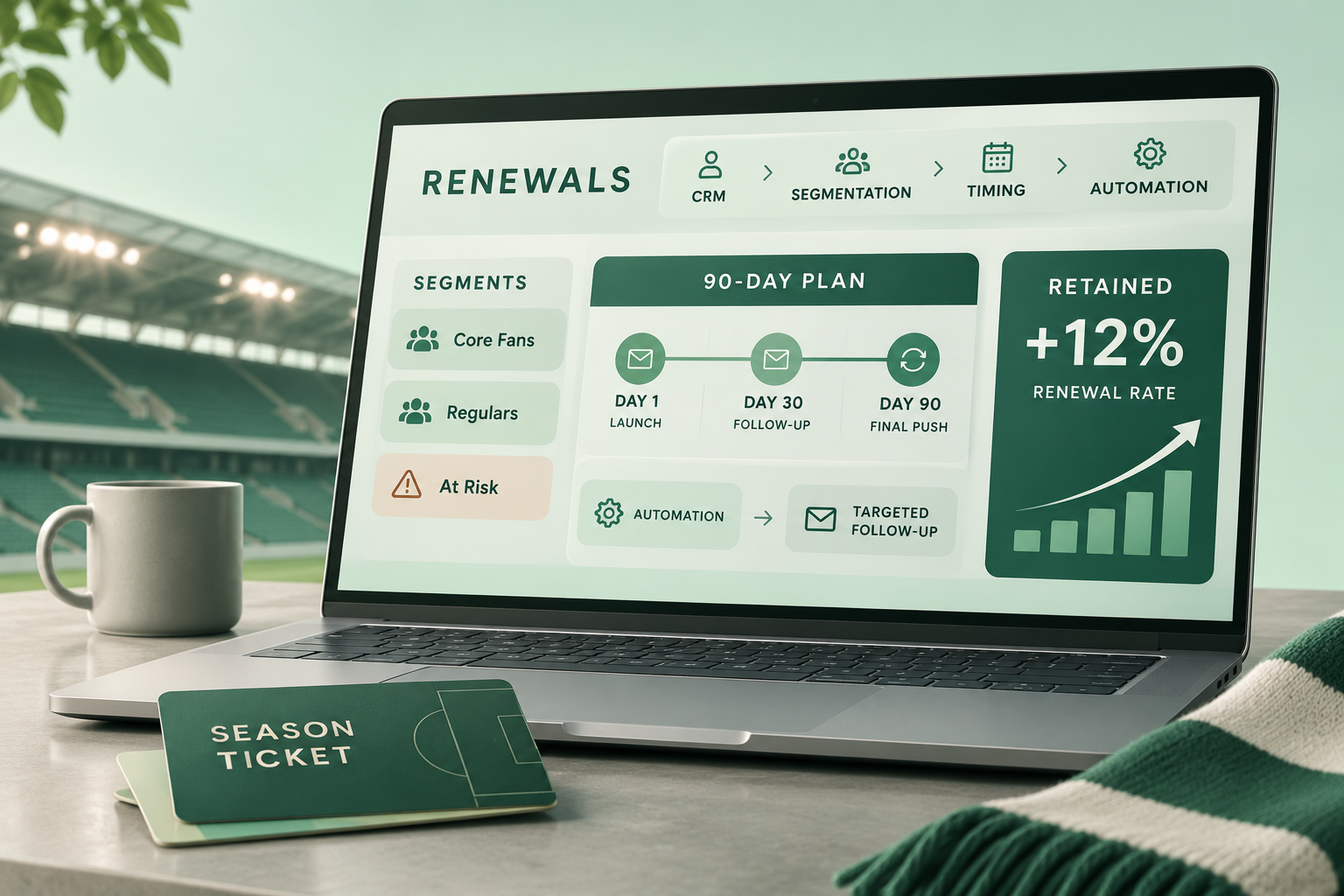
TL;DR: Season ticket renewals are the cheapest revenue a football club owns: the fans are already in the database, the seats are already sold, and every renewed ticket is budget you can bank before a ball is kicked. Clubs that renew well run a 90-day campaign with segments, churn signals, and automated journeys, with one deadline email playing no part in the plan. This guide covers the renewal rates to expect, the signals that predict non-renewal, and a week-by-week campaign calendar built for promotion and relegation reality.
Why season ticket renewals are the cheapest revenue you own
Your renewal window closes weeks before the new season opens. Whatever you renew by then, you keep. Whatever you lose, you replace through new-fan acquisition, and acquisition costs multiples of retention. Retention research has quantified this for decades: a 5% increase in customer retention produces more than a 25% increase in profit [1].
Run the model for a typical mid-sized club. 5,000 season tickets at an average of 320 euros is 1.6 million euros in renewal revenue on the table every single year. Lifting the renewal rate from 80% to 88% holds 400 more seats: 128,000 euros secured with zero acquisition spend, before you have sold a single new ticket. You can plug your own attendance and pricing into the club revenue calculator and see where season tickets sit in your revenue model; the full picture is in the club revenue formula.
What season ticket renewal rates look like
The clearest published benchmarks come from US sports, where ticketing teams report average season ticket holder renewal rates of 88% to 95% [2]. European clubs rarely publish their numbers, so treat that range as a reference point, with two caveats that matter more than the headline.
First, the average hides tenure. Holders in their first and second year churn at clearly higher rates than long-tenured ones [2]. A club that renews 90% overall can still lose a third of its newest cohort, which quietly erodes the base every season. The same pattern shows up one stage earlier: 80% to 85% of first-time ticket buyers never return to a second game [2], which makes the newest fans the most fragile revenue a club holds.
Second, the average hides sport. Team performance is a documented non-renewal reason [1], and European football adds a variable US leagues never face: promotion and relegation. A mid-table side and a side in a relegation fight face very different sentiment curves in the same renewal window. Plan for it: set pricing before the run-in, keep value messages independent of results, and prepare two message tracks, one for staying up and one for going down, so the final week of the campaign never turns into improvisation.
The signals that predict non-renewal
You do not need predictive software to see churn coming. Four signals cover most of it, and all four sit in data clubs already collect:
- Tenure. First- and second-year holders churn hardest [2]. Tag them as a segment from day one.
- No-shows. A holder who keeps the ticket and stops attending is signalling before the invoice does [2]. Reach out with a conversation, with another sales pitch as the last resort.
- Engagement decline. Email opens dropping, app usage fading, no shop or concession activity for months. Any sustained drop across channels warrants a check-in.
- Basket behaviour. Renewal email opened, pricing page visited, no purchase. That pattern reads as interest blocked by a barrier, usually price or payment timing, and it responds well to payment plans and a personal conversation.
Capture the touchpoints in your CRM as structured fields: contact date, touchpoint type, result, sentiment, and after the deadline, the reason for every non-renewal, using a fixed list such as cost, team performance, moving away, schedule, or financial hardship [1]. Reasons attached to segments turn next season's campaign from a broadcast into a targeted operation. The fan lifecycle framework explains where renewal-stage fans sit in the wider loyalty picture.
The 90-day season ticket renewal campaign calendar
A renewal campaign works as a sequence, with the deadline email at the end of a journey that started months earlier. Retention teams consistently find that the relationships deciding renewals are built in the first 90 days after a ticket is sold, which means the campaign for next season starts the day this season's tickets go out [1]. The core window runs 90 days before your renewal deadline [2], roughly like this:
| Phase | Audience | What runs |
| Weeks 1-2 (T-90) | All holders | Announce prices with an early-window incentive and a price-lock promise. Lead with the holder's own season: games attended, benefits used, savings versus single-game pricing. |
| Weeks 3-6 | First-year and second-year holders | Personal touches: a named contact, a call, a small gift or invitation. This cohort churns hardest, so it gets the most human attention. |
| Weeks 3-6 (parallel) | At-risk segment | No-shows and engagement decliners get a check-in triggered by CRM signals, focused on reconnection first and renewal second. |
| Weeks 7-10 | Price-sensitive and undecided | Payment-plan push and value framing: per-match cost, member savings, flexibility. Address the price objection directly before the deadline pressure starts. |
| Final 2 weeks | Open baskets and non-renewers | Urgency ramp with real deadlines: seat release dates, waitlists, price increases for new buyers. Rep outreach on every stalled basket. |
| Post-deadline | Lapsed holders | Win-back flow: a survey that segments by interest level, then targeted offers and rep follow-up on the responses. |
The win-back mechanics are well documented. Auburn's team segmented lapsed buyers by survey response, interested, unsure, or not interested, and routed each segment differently, with survey answers flowing into the CRM for sales follow-up [3]. Wake Forest sent dynamically personalized emails that carried the right rep's signature automatically [3]. West Virginia lead-scored contacts on location, purchase history, and engagement to decide who got a rep call and who got a nurture sequence [3]. All three are ordinary CRM and marketing automation work, the kind covered in the marketing automation playbook for smaller clubs.
Payment plans deserve their own line in the plan because they remove the biggest single barrier: the lump sum. Angel City FC sells renewals on interest-free monthly, 50/50, or pay-in-full plans, spread across up to 11 months, and frames membership as an average 30% saving per ticket versus single-game pricing [4]. Spreading the cost costs the club nothing it has earned already and converts price objections into scheduling conversations.
Measure the campaign, then feed it back
Four numbers tell you whether the campaign worked: renewal rate by segment, because the overall rate hides the cohorts that churn; revenue retained against the base; reasons captured per non-renewal; and cost per retained seat set against cost per newly acquired seat. Review all four after the deadline and attach last cycle's reason data to every account before the next campaign opens.
The journeys doing the weekly work are triggered sequences, and they only run if ticketing data reaches your CRM. The football CRM setup determines whether a no-show in March can trigger a check-in the same week. For renewal emails worth copying, the football email marketing swipe file collects real emails from professional clubs in one place.
Frequently Asked Questions
What is a good season ticket renewal rate?
US sports teams report average season ticket holder renewal rates of 88% to 95%, which is the best published benchmark available. A rate below the mid-80s usually signals a problem in a specific segment, typically first- and second-year holders, so track the rate by cohort and not only in aggregate.
When should a season ticket renewal campaign start?
The relationships that decide renewals are built in the first 90 days after a ticket is sold, so holder nurturing starts the day the current season's tickets go out. The active renewal campaign, with pricing and deadlines, typically runs the 90 days before the renewal deadline, with payment-plan and win-back phases after it.
Why do season ticket holders not renew?
Documented reasons include ticket cost, team performance, moving away, schedule conflicts, and financial hardship. The exact mix differs by club, which is why the campaign should capture a reason for every non-renewal in the CRM: the reasons, attached to segments, define next season's targeting.
How do you win back lapsed season ticket holders?
Segment first, then target. Survey lapsed holders and split them into interested, unsure, and not interested; route the interested ones to a direct purchase path and the others to a follow-up flow, with responses stored in the CRM. Lead scoring on purchase history and engagement tells you which accounts justify a personal call.
Do payment plans increase season ticket renewals?
Payment plans remove the lump-sum barrier, which is the most common practical blocker for renewing holders. Angel City FC offers interest-free monthly plans spread across up to 11 months alongside 50/50 and pay-in-full options, and clubs that offer instalments convert price objections into scheduling decisions.
How do you predict which season ticket holders will not renew?
Watch four signals: tenure, because first- and second-year holders churn hardest; no-shows, because a holder who stops attending is signalling early; sustained engagement decline across email, app, and shop activity; and basket behaviour, meaning opened renewal emails and pricing-page visits without a purchase. All four can trigger automated check-ins from the CRM.
Sources
- StellarAlgo, Maximizing Your Season Ticket Holder Renewal Rates with Data: https://stellaralgo.com/blog/maximizing-your-season-ticket-holder-renewal-rates-with-data-part-1/ (verified 2026-10-01)
- Sortment, How to Run Lifecycle Marketing for Sports Organizations: https://sortment.com/blogs/lifecycle-marketing-for-sports-organizations (verified 2026-10-01)
- Paciolan, Winning Back Season Ticket Holders: Three Proven Strategies: https://www.paciolan.com/post/winning-back-season-ticket-holders-three-proven-strategies (verified 2026-10-01)
- Angel City FC, 2027 Season Ticket Renewals: https://angelcity.com/tickets/season-tickets/renewals (verified 2026-10-01)


