






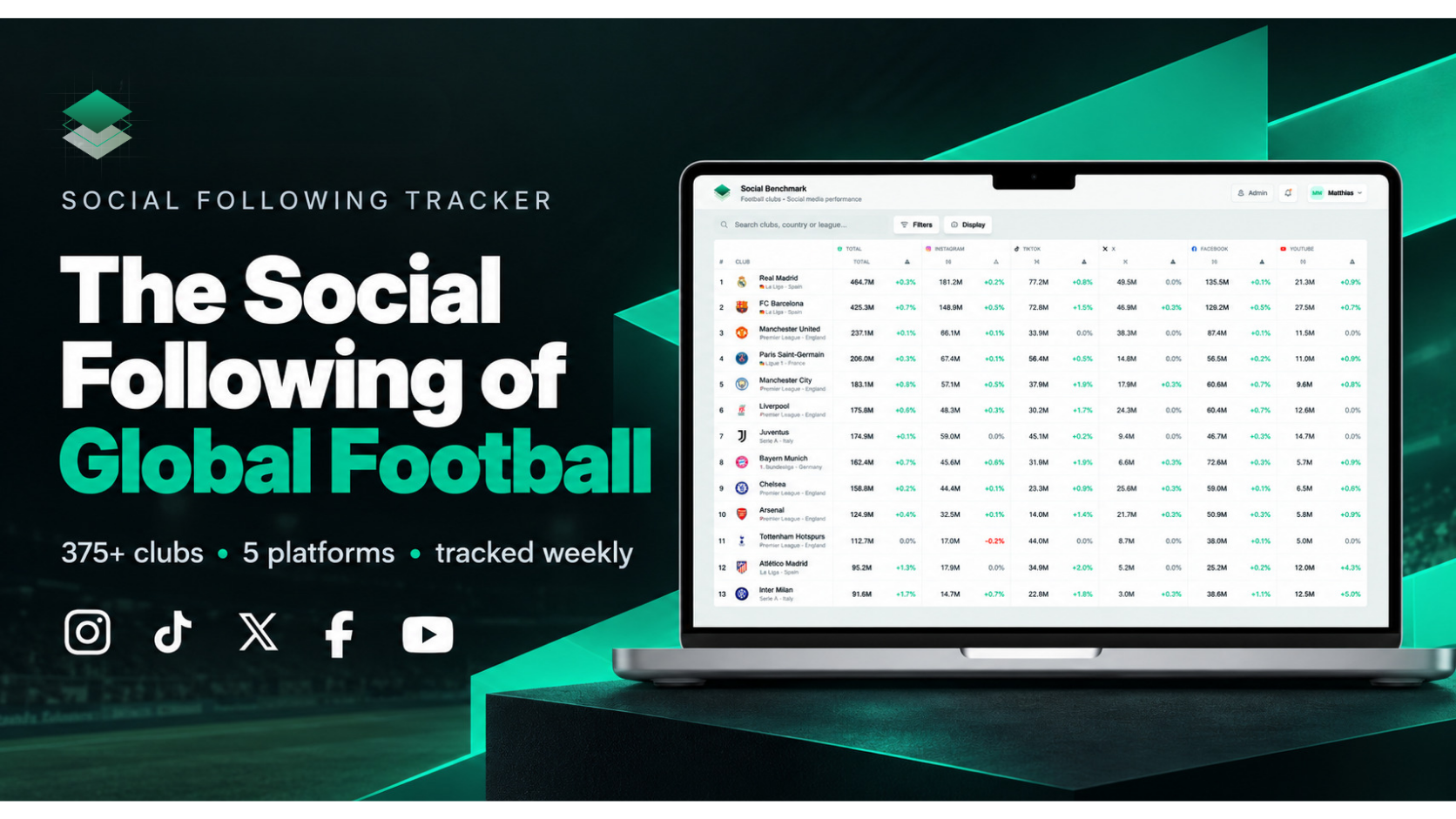
The Most Followed Football Clubs on Social Media
Reading time:
7 min


Transfers are among the most important decisions a football club makes.
But many still fail, even with more scouting, data, and market information than ever.
In this conversation, Dr. Patrick May, Founder of Board11, explains why the real challenge is not identifying good players, but identifying players who improve the team.
From independent predictive opinions to second-order effects and portfolio thinking, this interview explores how clubs can de-risk transfers and improve decision-making over time.

We don't help clubs find players. We help them make better decisions once players are already on the shortlist. Our role is to add an independent perspective from various predictive models. The goal is to improve the overall hit rate of recruitment decisions.
Football doesn't reward player performance-it rewards team performance. Yet most recruitment analysis focuses on describing individual players. The real challenge is understanding statistically how much a player moves the needle on winning matches and team success.
It starts with a definition. If transfer success means finding great players, you'll get one answer. If transfer success means improving team performance, you'll get a very different one. We believe the latter is what ultimately matters, and that's why we focus on connecting individual contributions to team success.
This interview hits on one of the most expensive problems in football:
Transfers are treated like individual bets, even though recruitment is really a portfolio of decisions.
That distinction matters.
A single transfer can be debated endlessly.
Good signing.
Bad signing.
Overpriced.
Undervalued.
Great talent.
Wrong fit.
Smart gamble.
Panic buy.
But from a club perspective, the more important question is not whether one player works out.
The real question is:
Is the club improving its transfer hit rate over time?
That is where Dr. Patrick May’s framing around Board11 becomes very interesting.
Board11 does not position itself as another scouting platform, another dashboard, or another data source. The role is more specific: an independent predictive opinion once players have already entered the recruitment funnel.
That is an important distinction.
They are not telling clubs how to scout.
They are not replacing internal recruitment teams.
They are not deciding which player profile a club should target.
Instead, they help assess which options are most likely to succeed once a shortlist already exists.
That is a powerful place to sit in the process.
Because this is exactly where many transfer decisions get risky.
By the time a player is seriously discussed, there is usually already some internal momentum.
A scout likes him.
The data team has flagged him.
An agent has offered him.
The coach has watched video.
The sporting director sees a market opportunity.
The board wants conviction.
At that point, the danger is not lack of information.
It is biased interpretation.
People start building the case for the option they already prefer.
And that is where an independent second opinion can create real value.
Not by replacing judgement, but by challenging it.
Patrick’s second point is also important:
Transfers still fail because football is not an individual sport in the way many datasets make it look.
Most data captures the individual player.
But football performance is deeply interdependent.
A player’s value depends on teammates, structure, communication, tactical role, positioning, decision-making, adaptation, coach fit, game model, league context, and the ability to make others better.
That is why traditional KPIs can be misleading.
Running fast does not mean running correctly.
Completing passes does not mean progressing the game.
Winning duels does not mean improving team control.
Having good individual numbers does not automatically mean the player increases team performance.
This is one of the core challenges in football analytics and transfer intelligence:
The player is not the product.
The team outcome is.
And that changes how recruitment should be evaluated.
The real task is not simply identifying good players.
It is identifying players who improve the team.
That sounds simple, but it is a completely different analytical problem.
It requires predictive recruitment models, squad fit analysis, team performance modelling, player development forecasting, risk assessment, market value logic, and financial decision-making to work together.
That is why Board11’s approach fits perfectly into the broader shift happening across football operations.
More data is not enough anymore.
Most clubs already have access to scouting reports, video, event data, physical data, market data, player databases, and agent networks.
The competitive advantage is no longer access.
It is synthesis.
Can the club combine different inputs into one decision view?
Can it understand not just player quality, but player impact?
Can it measure risk before the contract is signed?
Can it understand opportunity cost?
Can it compare sporting upside against transfer fee, wages, resale potential, contract length, and squad need?
Can it improve team probabilities per euro invested?
That last idea from Patrick is especially strong:
How many points can we generate per euro invested?
That is the kind of question football needs more often.
Because it connects recruitment with both sporting performance and financial sustainability.
A transfer is not successful just because a player looks good.
A transfer is successful if it improves the club’s probability of achieving its objectives.
More points.
Better squad balance.
Higher team performance.
Player development.
Market value growth.
Financial return.
Lower downside risk.
And ideally, those outcomes compound across several decisions.
That is why recruitment should be seen as a portfolio.
One signing can fail.
That will always happen.
Football is too complex to eliminate uncertainty.
But if a club consistently improves its expected decision quality, the long-term effect becomes meaningful.
Better squad construction.
More efficient spending.
Higher resale value.
Lower wage waste.
Fewer panic decisions.
More sustainable sporting success.
This is where I see a strong link to my own topics around CRM, RevOps, data strategy, and commercial systems in football.
Different department, same principle:
Data only matters if it improves decisions.
In CRM, that means better segmentation, campaign timing, retention, sponsorship activation, and revenue growth.
In recruitment, it means better player evaluation, transfer risk management, squad planning, and financial allocation.
The pattern is identical.
The clubs that win will not simply collect the most data.
They will build better decision systems.
They will connect information across silos.
They will reduce bias.
They will define the right problems.
They will translate insight into action.
And they will improve repeatedly, not occasionally.
Patrick’s point about second-order effects is especially important here.
Football is full of them.
A player can improve a teammate.
A player can change the team’s pressing structure.
A player can create space without touching the ball.
A player can make a system more stable.
A player can increase the value of others.
A player can also damage balance despite strong individual numbers.
Traditional transfer analysis often misses these effects because it looks at the player in isolation.
But clubs do not buy isolated performance.
They buy future contribution inside a specific team context.
That is why the next generation of transfer analytics, predictive scouting, squad planning, player valuation, football data science, and recruitment strategy needs to move beyond backward-looking KPIs.
The question is not only:
“What has this player done?”
It is:
“What is this player likely to do for us?”
And even more specifically:
“How does this player change our team probabilities, sporting upside, financial risk, and long-term squad value?”
That is a much better question.
And it is exactly why Board11’s positioning as an independent predictive opinion is compelling.
Not another dashboard.
Not another report.
Not another layer of noise.
A structured second opinion for transfer decisions that carry sporting and financial consequences far beyond the next window.
For me, the strongest takeaway is this:
Sustainable success in recruitment does not come from being right once.
It comes from increasing the quality of decisions over time.
That is true for transfers.
And frankly, it is true for almost every strategic function inside a football club.