






The Most Followed Football Clubs on Social Media
Reading time:
7 min


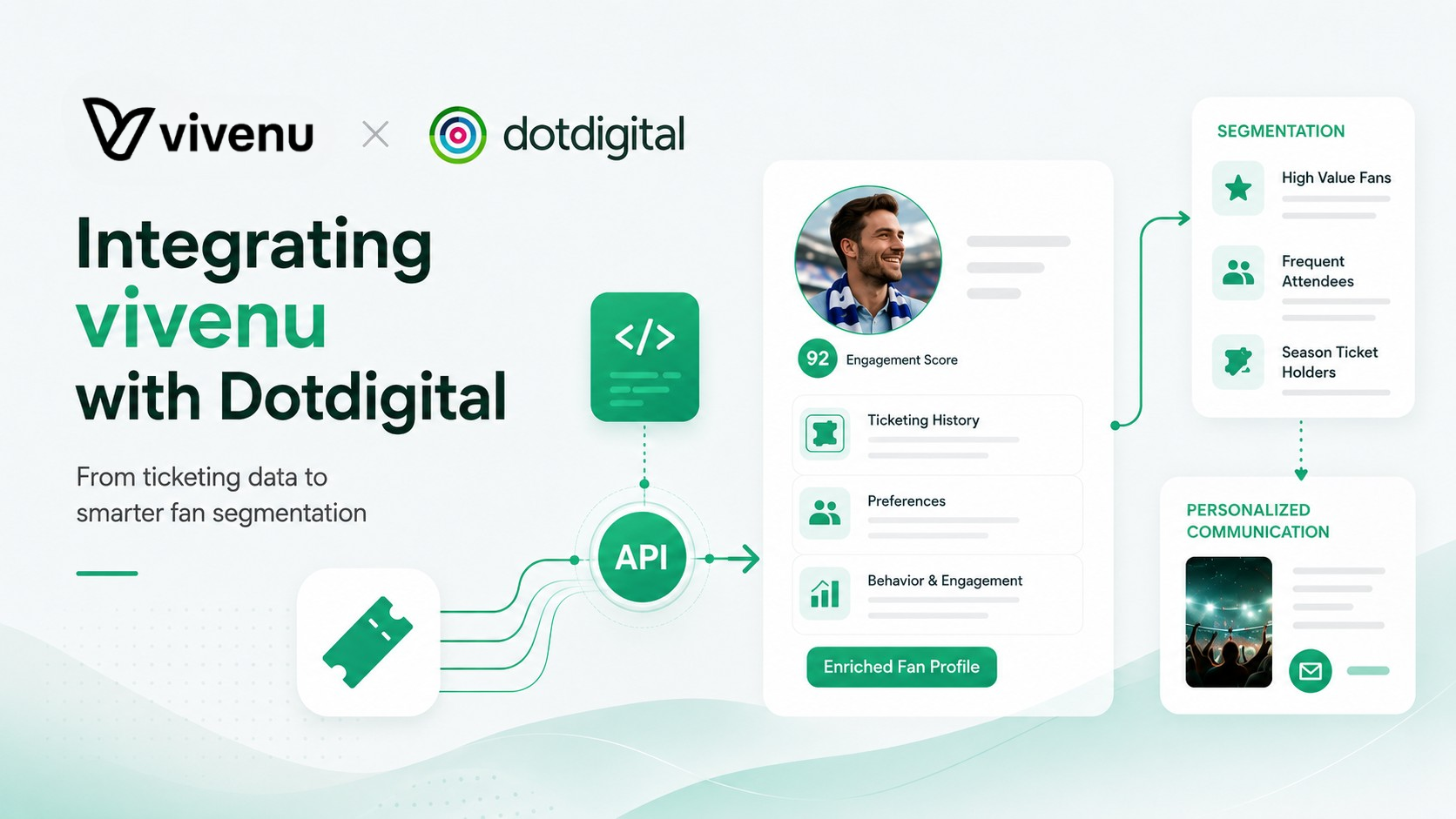
Ticketing is often treated as a transactional system. But under the surface, it defines how clubs control their data, shape fan experiences, and connect systems across their commercial stack.
In this conversation, Salvatore Guccione (vivenu) breaks down why the traditional ticketing model is broken and how an API-first, white-label approach changes the game.
From data ownership to seamless fan journeys, this is about more than selling tickets. It’s about building the infrastructure behind modern football operations.

The key difference lies in the platform’s philosophy: traditionally, ticketing providers have acted as brokers, leveraging the club’s appeal to build their own brands, forcing fans into their ecosystems, and often retaining control over the data. On the other hand, vivenu is designed purely as a technology solution. We provide the white-label infrastructure in the background, with the club’s brand at 100% centre stage.
Many legacy systems are closed ‘monoliths’ - they can do a bit of everything, but nothing particularly well, and are difficult to integrate with other software. ‘API-first’ means that vivenu has been programmed from the ground up so that it can communicate openly with practically any other system.
Clubs often look at things from the perspective of their own internal processes and, in doing so, overlook just how frustrating the “last mile” can be for the fan. The biggest underestimated friction points, in our opinion, are:
Most clubs still think of ticketing as a sales tool.
That framing is outdated.
What stood out in this conversation is that ticketing is not just about transactions. It is a control layer. A system that either enables or limits everything that happens downstream across CRM, marketing automation, sponsorship, and fan engagement.
Salvatore’s point about traditional providers acting as brokers is critical. For years, clubs have effectively outsourced not just distribution, but also control. Fans are pushed into external ecosystems, data is fragmented, and the club becomes one participant in a system it does not fully own.
That has real commercial consequences.
If you do not control your ticketing infrastructure, you do not fully control:
This is where the API-first approach becomes more than a technical detail.
It is an architectural decision.
Legacy ticketing systems are monoliths. They try to do everything inside one closed environment. The result is predictable:
An API-first ticketing platform flips this model.
Instead of being the system, it becomes infrastructure. Something that connects, rather than controls.
This allows clubs to:
In other words, ticketing becomes part of a broader RevOps and data architecture.
And that is where the real leverage sits.
The second major insight is around fan experience.
The “last mile” problems Salvatore describes are not edge cases. They are systemic.
The bounce effect, where fans are redirected to outdated portals, is a direct symptom of disconnected systems.
The friction in ticket transfer is a symptom of processes designed for internal control, not user experience.
The lack of mobile-native flows is a symptom of systems that have not adapted to how fans actually behave.
Individually, these issues look small.
Collectively, they destroy conversion rates, reduce engagement, and push fans towards workarounds like screenshots or secondary markets.
This is where ticketing connects directly to revenue.
Every extra step in checkout reduces conversion.
Every friction point reduces lifetime value.
Every disconnected system reduces the ability to activate fans commercially.
And yet, many clubs still optimize for internal processes instead of fan journeys.
That is the core mismatch.
Modern ticketing is not merely about selling access to a match.
It is about:
If you look at leading digital businesses outside football, this is standard.
Seamless checkout.
One login across products.
Integrated data across systems.
Football is catching up.
The takeaway is simple:
Ticketing is not a standalone system.
It is a foundational layer in your CRM, data, and revenue infrastructure.
And the clubs that treat it that way will have a structural advantage.