






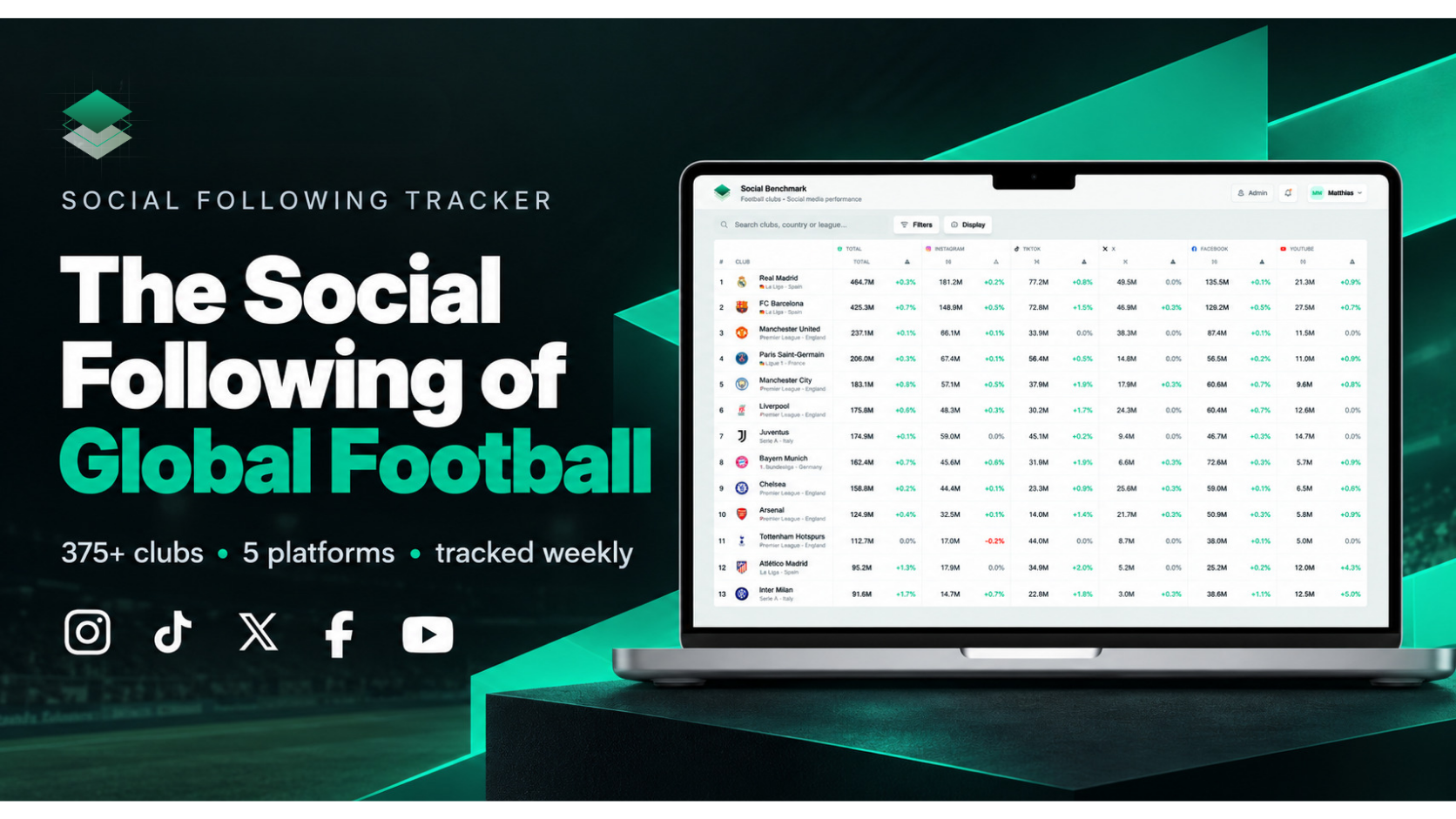
The Most Followed Football Clubs on Social Media
Reading time:
7 min


Most clubs set their ticket prices once and hope they got it right. But what happens when demand shifts after kickoff is still days away?
Filippo Scanzano, Country Manager DACH at Smart Pricer, shares how dynamic pricing is changing the way clubs approach ticketing. Drawing on his experience across entertainment, ticketing, and sports, he explains why static pricing often leaves revenue on the table, how real-time data signals like demand, performance, and external factors shape pricing decisions, and how clubs can balance commercial optimisation with fan trust. This conversation reframes pricing as a continuous, data-driven process rather than a one-time decision.

Between your assumption before the season, when you go on sale and the kickoff you may have won a lot of games, signed a new star or mispredicted your opponent or the weather. Stay flexible and quickly react to changing circumstances and demand - in whatever direction. You miss out on revenue opportunities (worse: leave the margin to the black market!) in a confined static setting, whereas you can dynamically react based on current live-data with the respective system in place.
Obviously the attractiveness of the opponent and your current sportive performance - also historic ticket sales and many external factors such as online traffic or the weather. Collected and processed automatically in a structured way, as opposed to the gut feeling of a single person in a random moment, they are a very precise and rational 24/7 model to steer ticketing strategies depending on the club's goal for any given match, e.g. yield 5-15% increased revenue or 3-8% higher attendance.
Fans don't like unpredictability, but if used correctly, dynamic pricing is a proven tool to manage attendance, boost early bookings and optimize revenue, while incentivizing loyal fans that buy early at the same time! The pricing strategy is the club's decision, they need to balance between fan opinion and commercial needs. We recommend: the local family that plans in advance pays less than the last-minute tourist. Many innovative sport clubs are doing this already successfully.
This interview hits on a topic that is still surprisingly underdeveloped in football: pricing.
Not because clubs don’t care about revenue. Quite the opposite. But because pricing is still often treated as a one-time decision, not as a continuous system.
Most clubs set their prices before the season or a match phase and then move on. The assumption is that demand can be predicted in advance with reasonable accuracy. Filippo’s perspective challenges exactly that assumption.
Between ticket release and kickoff, a lot can change.
A winning streak shifts demand.
A new signing changes attention.
Weather impacts last-minute decisions.
Even online traffic can signal demand patterns.
If pricing remains static, all of this information is ignored.
The consequence is not theoretical. It is very real.
Clubs either leave revenue on the table or unintentionally push demand into secondary markets. In the worst case, the margin is captured by resellers instead of the club itself. That is not just a pricing issue. It is a structural leakage of value.
What I find particularly compelling is how dynamic pricing reframes ticketing from a planning exercise into a decision system.
Instead of relying on gut feeling or a one-off forecast, pricing becomes a function of continuously updated data inputs. Historic sales patterns, current performance, opponent attractiveness, and external signals like weather or digital demand are processed into a structured model.
This is where the connection to my core topic becomes very clear.
This is not just about pricing.
This is about data-driven decision-making in football.
The shift Filippo describes is very similar to what we see in CRM and marketing automation.
You move from:
And the result is measurable.
Filippo mentions concrete outcomes like:
Those are significant numbers in an industry where marginal gains matter.
Another important aspect is the perception from fans.
Dynamic pricing often triggers concerns around fairness. And rightly so, if implemented poorly. But Filippo makes an important distinction: unpredictability creates frustration, not pricing itself.
If pricing rewards early commitment and transparency, it can actually strengthen fan behaviour patterns. The example of early buyers paying less than last-minute buyers is well established in other industries. It creates incentives rather than friction.
From a CRM and fan engagement perspective, this is highly relevant.
Pricing is not isolated.
It is part of the overall fan journey.
When pricing, communication, and segmentation are aligned, clubs can:
This is where I see a broader opportunity.
Many clubs invest in CRM, marketing automation, and data infrastructure. But pricing is often disconnected from these systems. It remains a separate domain, handled in isolation.
That is a missed opportunity.
Dynamic pricing should be integrated into the broader commercial operating system of a club. It should connect with:
Only then can clubs fully leverage the potential.
For anyone working in:
this interview is highly relevant.
Because it shows that pricing is not just a number.
It is a lever.
And like most levers in football, its impact depends on how systematically it is used.