The Matchday CRM Playbook: How Smart Clubs Turn Kickoff Into Data


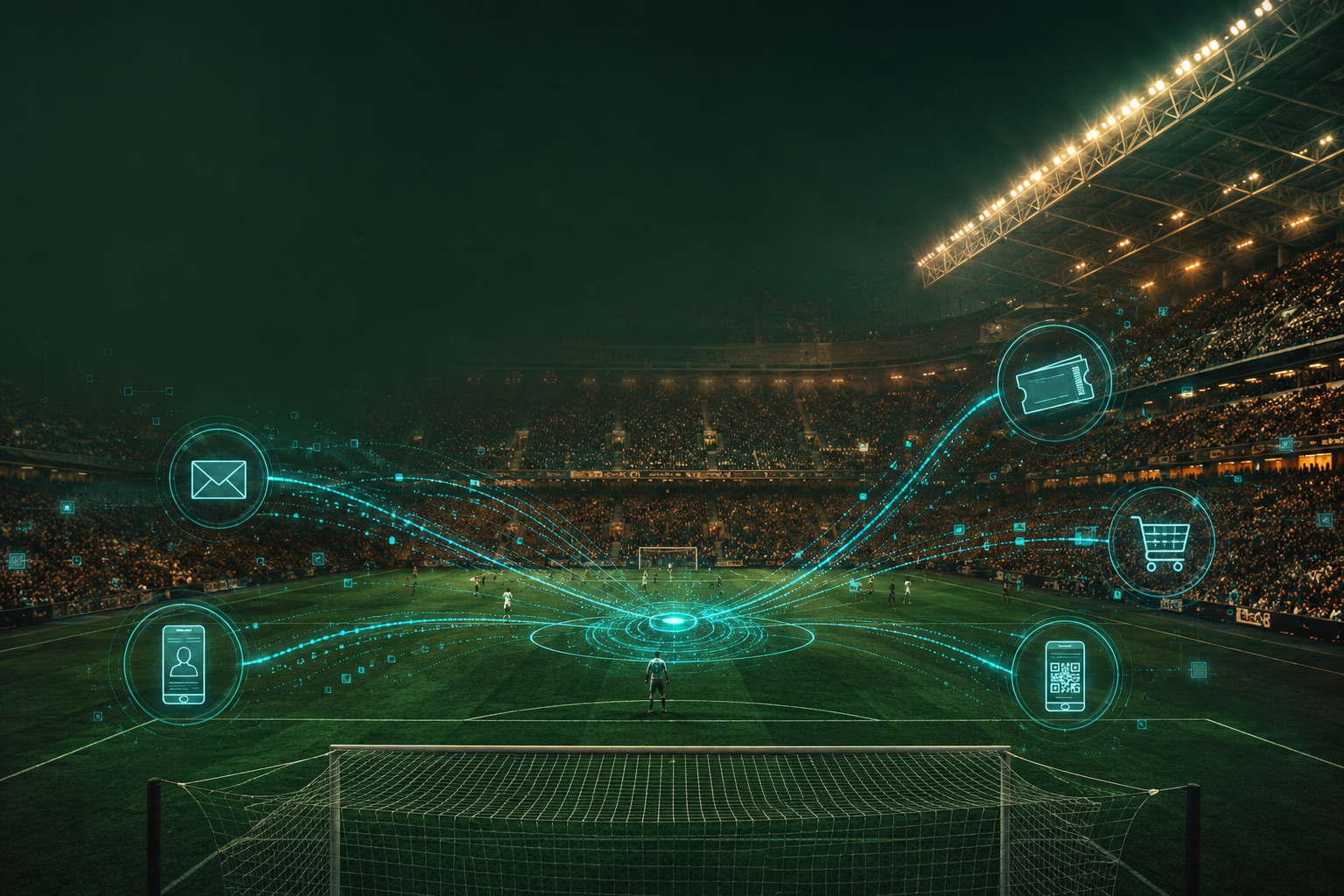
TL;DR: Matchday is the richest data day in a club's calendar. Most clubs waste it by treating matchday as pure operations. When you map the journey into three CRM triggers — pre-match intent, in-stadium behavior, post-match sentiment — and wire the signals back to your CRM, engagement jumps 2-3x over generic newsletter blasts. The anchor signal? Ticket scans. Everything else builds from there.
Matchday Is Your Richest Data Day (And You're Wasting It)
A club with 25,000 season ticket holders runs 17 home league matches a year. That's at least 425,000 individual attendance events. Every one of them is a CRM data point that most clubs never capture.
The turnstile beep is the most underrated signal in football marketing. It tells you a fan showed up. It tells you they followed through on intent. It tells you they're engaged enough to leave their house on a cold Tuesday night in February. And yet, in most clubs, that scan event lives in the ticketing system and dies there. It never reaches the CRM.
Some clubs get excited about stadium Wi-Fi logins and cashless concession data. Those are useful signals, but they're advanced. They require infrastructure that many small and mid-sized clubs simply don't have. Worse, chasing them before you've nailed the basics is a distraction.
The foundation is simpler than that: ticket purchase → ticket scan. If those two events aren't flowing into your CRM or CDP, nothing else matters.
Once they are, something clicks. You can answer questions that most clubs guess at: Who bought but didn't show? Who attends every game? Who brought a friend in March and hasn't been back since? Matchday stops being an operational firefight and becomes your richest data capture window.
The Pre-Match Window: Capturing Intent Before Kickoff
The matchday data opportunity starts days before anyone walks through the gate. The pre-match window — roughly 72 hours before kickoff to the moment the turnstile beeps — is packed with signals.
Ticket purchase. The most obvious one. A fan buying a ticket isn't just spending money. They're declaring intent. Segment buyers by match, stand, price tier, and purchase channel. A fan who buys a Category A ticket three weeks in advance is not the same CRM contact as someone who grabs a last-minute Category C seat on matchday morning.
Pre-match communication behavior. If you send a matchday preview email or push notification, track who opens it. Track who clicks on the squad announcement. Track who checks the weather widget. These micro-signals build a pre-match engagement profile that sharpens your segmentation.
Pre-match expectation surveys. One of the simplest tools most clubs ignore. Send a one-question survey 24 hours before kickoff: "What are you most excited about today?" with options like "The atmosphere," "Seeing a specific player," "The tactical matchup," "Just being back at the ground." You get sentiment data. You get preference data. You get content hooks for your matchday social feed. And it costs nothing to run.
In-Stadium Triggers: The Turnstile Beep and What Comes After
The turnstile is the moment of truth. A fan buys a ticket, walks to the stadium, queues up, and scans. That scan should fire an event in your CRM immediately not batched overnight, not exported next week.
Why real-time matters: if a season ticket holder hasn't scanned by the 15th minute, you have a no-show. You can trigger a follow-up within hours not days later when they've already forgotten they missed the match. If a first-time buyer scans, you know they actually showed up. That changes what you send them post-match.
Gamification and QR code campaigns. This is where in-stadium engagement gets interesting and trackable. During half-time, put a QR code on the video cube that links to a quick raffle entry. "Scan to win a signed shirt." Every scan is a CRM event tied to a known fan. Now you know who's in the stadium, who's engaged, and who's paying attention to the screen.
Take it further: place unique QR codes at different fanzone booths. The code at the sponsor activation tent is different from the one on the concourse pillar by Gate B. Now you're tracking fan movement. You know which activations draw traffic and which ones fans walk past. You can report that back to sponsors with actual numbers not "good visibility," but "143 scans during a single half-time window."
The same principle works pre-match. Put a QR code on the digital team-sheet display in the fanzone. Fans scan it, see the lineup, and enter a prediction contest. You capture their email, their matchday attendance, and their engagement preference in one interaction.
None of this requires an app. A mobile-friendly web form behind a QR code is enough. The key is that each code is unique to its location, so the CRM knows where the fan engaged.
Sponsor activations. Once you have scan data flowing, sponsor activations become measurable. You can segment fans who engaged with a sponsor booth and send them a follow-up from that sponsor post-match. That's the kind of proof sponsors actually want. Not impressions, but interaction.
Stadium Wi-Fi and cashless payments. These are real signals. A Wi-Fi login tells you a fan is physically present and actively engaging. A cashless F&B transaction tells you they bought a pie and a pint at minute 38. If your infrastructure supports these, capture them. But they're layer two. Get the ticket scan right first. Then the QR codes. Then, if you have the setup, add Wi-Fi and cashless data to enrich the profile. Don't let "we need better stadium tech" become an excuse for doing nothing.
Post-Match Sentiment: The 48-Hour Goldmine
The 48 hours after the final whistle is when fan sentiment is at its peak, and at its most actionable. The result shapes everything.
After a win, fans are primed for merch. Open rates spike. Click-through on shop links jumps. A triggered email hitting inboxes within 90 minutes of the final whistle outperforms a generic "shop now" blast sent Tuesday morning by multiples.
After a loss, the playbook changes. Merch emails feel tone-deaf. Instead, acknowledge the result. A simple "Not the result we wanted, here's what's next" keeps the relationship warm without selling.
Surveys: the highest-ROI tool most clubs underuse. Surveys belong in every phase of the matchday journey, but post-match is where they earn their keep. They're cheap to run, easy to automate, and produce data that directly feeds segmentation and personalization.
Post-match sentiment surveys. Send within 24 hours of the final whistle. Keep it short: two or three questions max. "How was your matchday experience?" with a simple scale. "What would improve your next visit?" with an open text field. The responses give you sentiment data by fan segment — season ticket holders vs. occasional attendees, stand A vs. stand B.
No-show surveys. This is the one that surprises most clubs. A fan buys a ticket and doesn't scan it. Instead of silently marking them as absent, send a short survey within 24 hours. "We missed you at the match — was there something that kept you away?" Options: "Last-minute conflict," "Travel issues," "Forgot," "Ticket transfer didn't work," "Other." The data is gold. If 30% of no-shows cite travel disruption on a specific fixture, you have an operational insight. If 15% cite a broken ticket transfer process, you have a product issue to fix. And if someone consistently buys and doesn't attend, you have a different kind of fan — high intent but low follow-through — who needs a different nurturing path.
Pre-match expectation surveys. The pre-match survey sets a baseline you can compare against post-match sentiment. Did fans who were "excited about the atmosphere" rate their experience higher? Did fans focused on the tactical matchup engage more with post-match analysis content? Connecting pre-match expectation to post-match sentiment builds a feedback loop that sharpens every campaign.
Wiring It Back: How to Connect Matchday Signals to Your CRM
All of this is worthless if the signals stay siloed. The ticket scan in the access control system, the QR code scan on the concourse, the survey response in Typeform they need to land in the same CRM record.
The practical path for most clubs:
Event-based triggers. Don't run batch imports. Set up real-time or near-real-time event flows. A scan happens → a webhook or an API call fires → the CRM updates the contact record with a timestamp and event type. Most modern ticketing platforms have webhook capabilities. If yours doesn't, a scheduled export every 15 minutes is an acceptable fallback.
Unified fan ID. Every interaction — ticket purchase, scan, QR code engagement, survey response — must resolve to the same contact. Email is the most practical identifier for most clubs. If you're using a CDP, it handles identity resolution. If you're on a CRM-only stack, make email matching your non-negotiable data hygiene rule.
Segment automation. Once events land in the CRM, attach them to segments. "Attended last 3 home matches." "No-show last 2 fixtures." "Scanned QR code at sponsor activation." "Completed post-match survey." These segments then power the automations.
Three Automations You Can Launch Before Next Season
You don't need a full-scale CRM overhaul to start.
1. The Pre-Match Welcome. Triggered 24 hours before kickoff for every ticket buyer. Includes: practical info (gate opening time, travel updates), a one-click add-to-calendar link, and a pre-match expectation survey. It's useful first, data capture second. Open rates on these routinely hit 60-70%.
2. The Post-Match Follow-Up. Two variants, triggered by result. After a win: match highlights, player ratings link, and a shop CTA timed within 90 minutes. After a loss or draw: a brief message acknowledging the result, and a link to post-match analysis. Both variants include a 2-question sentiment survey.
3. The No-Show Re-Engagement. Triggered when a ticket is purchased but no scan is recorded within 60 minutes of kickoff. A short email lands within 2 hours: "We missed you." Includes the no-show survey and doesn't punish the fan. The tone is curious, not accusatory. Fans who respond are routed into a re-engagement sequence. Fans who no-show twice in a row get a different path — a "still interested?" check-in before the next home fixture.
Frequently Asked Questions
What matchday data should a club prioritize capturing?
Start with attendance confirmation (who actually showed up, not just who bought), Wi-Fi or app engagement events, and post-match survey responses. These three signals feed the most CRM segments, including re-engagement targeting, loyalty scoring, and satisfaction tracking, and require the least infrastructure to implement.
How should clubs handle post-match communication after a loss?
Match the message to the emotional context. Focus on feedback requests, service acknowledgment, and community messaging. Avoid promotional content and merchandising immediately after a significant loss. A well-timed feedback survey with a we hear you approach generates higher engagement than a tone-deaf upsell attempt.
What CRM platform capabilities does a matchday data setup need?
The most important capability is dynamic segment membership and event-based automation triggers. Dotdigital, HubSpot, and Salesforce all support this model. The limiting factor is usually not the CRM platform but the data plumbing between matchday systems (ticketing, POS, app) and the CRM.
How long does it take to set up matchday-to-CRM automations?
The event architecture (central event table, fan ID resolution, nightly reconciliation) is the longest part. It takes one to two weeks with a developer. Each individual automation (pre-match emails, post-match merch, attendance re-engagement) takes half a day to configure once the architecture exists.
Can small clubs without stadium Wi-Fi still use matchday CRM data?
Yes. Ticket purchase data and post-match surveys work regardless of stadium infrastructure. App-based engagement requires a club app, but ticketing and survey data are accessible to most clubs. Stadium Wi-Fi adds another signal layer but is not a prerequisite.


